The Belief that Must Not Be Named

The Church’s website includes a 2022 news release titled “A New Pamphlet Urges Understanding Between Muslims and Latter-day Saints.” This news release highlights shared beliefs between Islam and the Latter-day Saint tradition.
Shared Beliefs
“While acknowledging differences between the two religions, sections in the pamphlet illustrate some of the shared beliefs. For example:
God is omniscient and omnipotent. Faith should be expressed in thought, word and action.
Prophets are vital in providing guidance from God.
Jesus Christ plays an important, though different, role for both groups.
Revelation from God given through messengers as scripture is the foundation for learning God’s will, keeping commitments and participating in faithful worship.
Human beings must communicate with God through daily prayer.
God delights in purity and chastity.
Women are essential in society and in the home.
Family is the fundamental unit of society and an essential source of joy.”
Guess which shared belief is absent from this list?
The Shared Belief That Must Not Be Named
The obvious point of comparison the pamphlet does not mention is that both religions have scriptural texts that permit a man to have more than one wife.
Although Latter-day Saints generally consider themselves Christian, most Christian traditions reject polygamy, and they have nothing comparable to Section 132 establishing multiple wives as a religious principle.
So, I would like to look at the two faiths compared in the Church’s pamphlet and contrast their scriptures that allow for multiple wives.
Now, I am not considering the current or historical treatment of women in Muslim societies or in the various branches of the Latter-day Saint movement.
Nor am I considering the Bible, which I have explained elsewhere why I do not believe it commands or endorses polygamy. At the same time, I am setting aside the Book of Mormon, and other Doctrine and Covenant passages that teach monogamy.
My focus is much narrower: What do the Qur’an and Section 132 say about plural marriage?
The Quran’s View
Let’s start with the Quran. Full disclosure: I have not read the entire Quran. What little I have read has been in English, and my understanding is limited to my research.
The two verses most directly relevant to plural marriage are Qur’an 4:3 and 4:129. Chapter 4 deals extensively with women, marriage, family relationships, inheritance, and orphans.
I’ve included verse 2 for context:
2. And give orphans their properties, and do not substitute the bad for the good. And do not consume their properties by combining them with yours, for that would be a serious sin.
3. If you fear you cannot act fairly towards the orphans—then marry the women you like—two, or three, or four. But if you fear you will not be fair, then one, or what you already have. That makes it more likely that you avoid bias.
Verse 3 permits up to four wives, but if a man fears he cannot be fair, he is directed to marry one. The connection to orphans has been interpreted in different ways. There’s an early interpretation that relates the passage to guardians marrying orphaned women under their care while failing to give them their full rights.
Next is Qur’an 4:129:
129. You will not be able to treat women with equal fairness, no matter how much you desire it. But do not be so biased as to leave another suspended. If you make amends, and act righteously—God is Forgiving and Merciful.
Some Muslims understand these passages as favoring monogamy; others as permitting polygyny when its conditions are met. Either way, concern for justice toward the wives is explicit.
Something else to consider: the Qur’an’s plural marriage passages regulate earthly marriage only. One passage (Quran 13:23) describes the righteous entering paradise with their parents, spouses, and families, but it does not present plural marriage as eternal.
D&C 132’s View
Now let’s look at D&C 132.
Based in part on the 1886 John Taylor revelation, I interpret the “new and everlasting covenant” in this context as referring to plural marriage. But not everyone agrees, so I will omit those verses. Of course, I also believe the opening verses of Section 132 establish multiple wives, or as the section calls it: the doctrine of having many wives and concubines, as the subject of the entire section. I’ve explained my reasoning in other posts.
For this comparison, though, I will set aside questionable verses, and only consider those that clearly relate to plural marriage. I came up with 21 of the 66 verses in the section. Here’s where we start:
1 Verily, thus saith the Lord unto you my servant Joseph, that inasmuch as you have inquired of my hand to know and understand wherein I, the Lord, justified my servants Abraham, Isaac, and Jacob, as also Moses, David and Solomon, my servants, as touching the principle and doctrine of their having many wives and concubines—
2 Behold, and lo, I am the Lord thy God, and will answer thee as touching this matter.
These first two verses establish the question Section 132 will answer: how God justified ancient servants in having many wives and concubines.
29 Abraham received all things, whatsoever he received, by revelation and commandment, by my word, saith the Lord, and hath entered into his exaltation and sitteth upon his throne.
30 Abraham received promises concerning his seed, and of the fruit of his loins—from whose loins ye are, namely, my servant Joseph—which were to continue so long as they were in the world; and as touching Abraham and his seed, out of the world they should continue; both in the world and out of the world should they continue as innumerable as the stars; or, if ye were to count the sand upon the seashore ye could not number them.
31 This promise is yours also, because ye are of Abraham, and the promise was made unto Abraham; and by this law is the continuation of the works of my Father, wherein he glorifieth himself.
32 Go ye, therefore, and do the works of Abraham; enter ye into my law and ye shall be saved.
33 But if ye enter not into my law ye cannot receive the promise of my Father, which he made unto Abraham.
34God commanded Abraham, and Sarah gave Hagar to Abraham to wife. And why did she do it? Because this was the law; and from Hagar sprang many people. This, therefore, was fulfilling, among other things, the promises.
35 Was Abraham, therefore, under condemnation? Verily I say unto you, Nay; for I, the Lord, commanded it.
Verses 29–35 refer to multiple wives because Abraham, Sarah, and Hagar become the example for the practice. Sarah gave her slave to Abraham to have a child through her. D&C 132 uses that deeply complicated Genesis story as a precedent for plural marriage: “this was the law.”
It’s important to remember that Hagar is not merely the woman Sarah uses as a surrogate. In Genesis, God sees Hagar’s distress, and the angel of the Lord appears and speaks to her, a woman, on two occasions. God promises a future for her son. Genesis presents Hagar as someone God sees and cares about. Section 132, on the other hand, strips all of that away and makes Hagar primarily a precedent for a law.
36Abraham was commanded to offer his son Isaac; nevertheless, it was written: Thou shalt not kill. Abraham, however, did not refuse, and it was accounted unto him for righteousness.
The placement of the Isaac story here, in verse 36, invites a strange comparison. Abraham was commanded to do something otherwise forbidden, and his willingness to obey was counted as righteousness. But he did not sacrifice Isaac; God stopped him.
By contrast, the plural marriages invoked in the surrounding verses actually occurred. Section 132 appears to use the Isaac story to establish that a command from God can transform an otherwise prohibited, sinful act into a righteous one—even though, in Isaac’s case, the prohibited act was never carried out.
37Abraham received concubines, and they bore him children; and it was accounted unto him for righteousness, because they were given unto him, and he abode in my law; as Isaac also and Jacob did none other things than that which they were commanded; and because they did none other things than that which they were commanded, they have entered into their exaltation, according to the promises, and sit upon thrones, and are not angels but are gods.
38 David also received many wives and concubines, and also Solomon and Moses my servants, as also many others of my servants, from the beginning of creation until this time; and in nothing did they sin save in those things which they received not of me.
39David’s wives and concubines were given unto him of me, by the hand of Nathan, my servant, and others of the prophets who had the keys of this power; and in none of these things did he sin against me save in the case of Uriah and his wife; and, therefore he hath fallen from his exaltation, and received his portion; and he shall not inherit them out of the world, for I gave them unto another, saith the Lord.
Verses 37–39 describe Abraham’s concubines as divinely given and his receiving them as righteous. David’s wives and concubines are also said to have been given to him by God, with the exception of Bathsheba.
52 And let mine handmaid, Emma Smith, receive all those that have been given unto my servant Joseph, and who are virtuous and pure before me; and those who are not pure, and have said they were pure, shall be destroyed, saith the Lord God.
53 For I am the Lord thy God, and ye shall obey my voice; and I give unto my servant Joseph that he shall be made ruler over many things; for he hath been faithful over a few things, and from henceforth I will strengthen him.
54 And I command mine handmaid, Emma Smith, to abide and cleave unto my servant Joseph, and to none else. But if she will not abide this commandment she shall be destroyed, saith the Lord; for I am the Lord thy God, and will destroy her if she abide not in my law.
In verses 52-54, Emma is commanded to “receive all those that have been given” to her husband, and she’s commanded to “abide and cleave” to him. She is warned twice in verse 54 that she’ll be “destroyed” if she doesn’t.
Church teaching materials interpret “destroyed” in Section 132 as being cut off or separated from God. Even with that interpretation, the spiritual threat is severe.
61 And again, as pertaining to the law of the priesthood—if any man espouse a virgin, and desire to espouse another, and the first give her consent, and if he espouse the second, and they are virgins, and have vowed to no other man, then is he justified; he cannot commit adultery for they are given unto him; for he cannot commit adultery with that that belongeth unto him and to no one else.
62 And if he have ten virgins given unto him by this law, he cannot commit adultery, for they belong to him, and they are given unto him; therefore is he justified.
63 But if one or either of the ten virgins, after she is espoused, shall be with another man, she has committed adultery, and shall be destroyed; for they are given unto him to multiply and replenish the earth, according to my commandment, and to fulfil the promise which was given by my Father before the foundation of the world, and for their exaltation in the eternal worlds, that they may bear the souls of men; for herein is the work of my Father continued, that he may be glorified.
In verses 61-63, if a man desires another virgin and the first wife gives her consent, he may marry another without committing adultery. The text says the women are “given unto him” and “belong unto him.” Verse 62 gives the example of ten wives, although ten is not stated as a limit.
Verse 63 says the women are given to the man to “multiply and replenish the earth” and connects the arrangement with “exaltation in the eternal worlds.”
Church teaching materials say that "given" and "belong" should not be interpreted as meaning women were property, and say women were free to choose whether to marry. In my opinion, the pressure Section 132 places on women to accept plural marriage makes that freedom debatable.
64 And again, verily, verily, I say unto you, if any man have a wife, who holds the keys of this power, and he teaches unto her the law of my priesthood, as pertaining to these things, then shall she believe and administer unto him, or she shall be destroyed, saith the Lord your God; for I will destroy her; for I will magnify my name upon all those who receive and abide in my law.
65 Therefore, it shall be lawful in me, if she receive not this law, for him to receive all things whatsoever I, the Lord his God, will give unto him, because she did not believe and administer unto him according to my word; and she then becomes the transgressor; and he is exempt from the law of Sarah, who administered unto Abraham according to the law when I commanded Abraham to take Hagar to wife.
In verse 64, if a man teaches his wife “the law of the priesthood,” she is told to “believe” and “administer unto him,” or she will be destroyed.
Verse 65 says that if the wife refuses to receive the law, the husband may go ahead and receive what God gives him. She becomes “the transgressor,” while he is exempt from the law of Sarah. The 132 text does not explain exactly what “administer unto him” requires. Church materials are vague and refer to the precedent of Sarah, who “administered unto Abraham” when Hagar was given to him as a wife. What is clear from the Church's own student manual is that Emma has an obligation to support Joseph in marrying additional women.
Let’s Compare
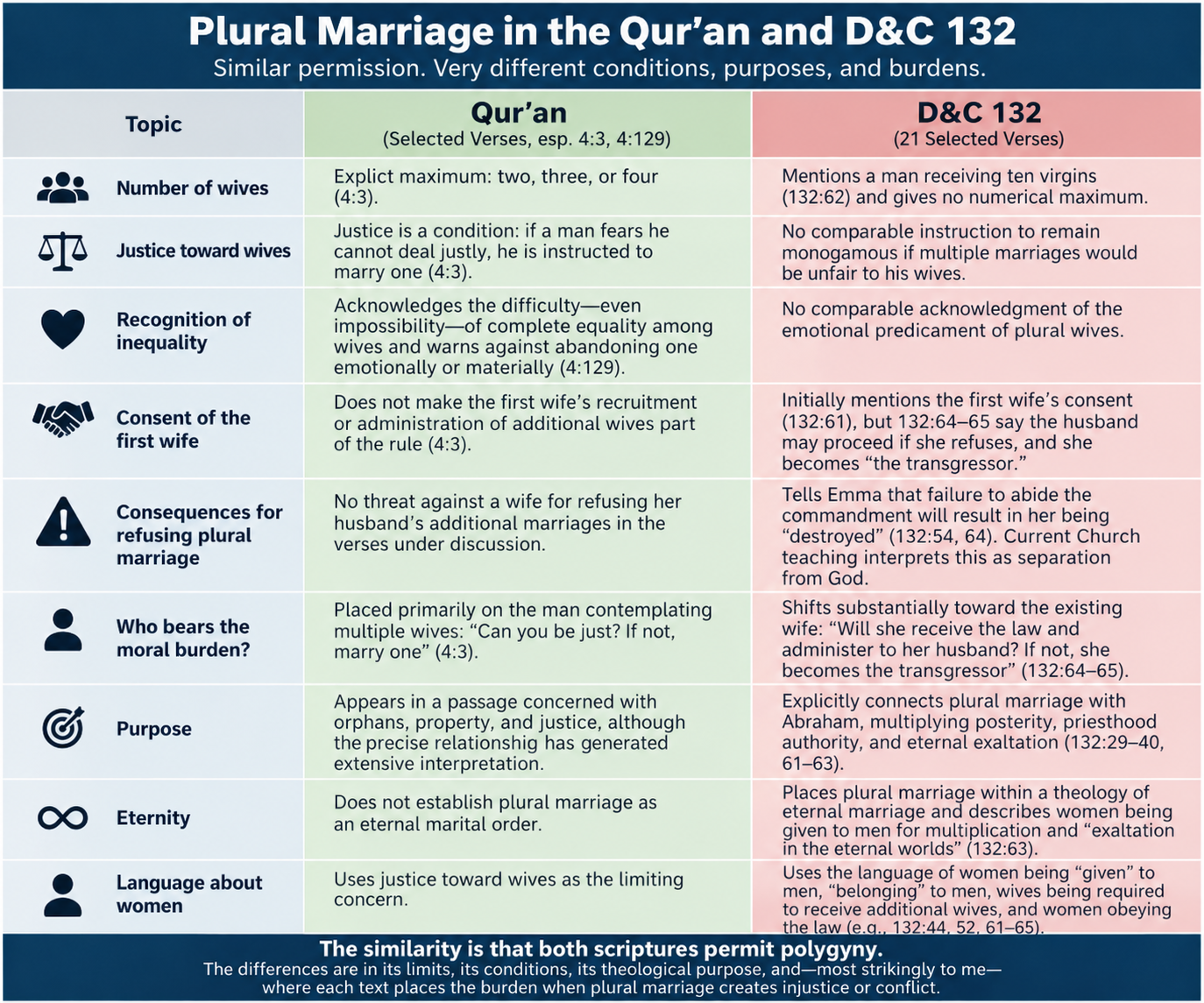
So, let’s compare. Both texts permit a man to have more than one wife. Beyond that basic similarity, however, they treat plural marriage quite differently.
Number of wives.
The Qur'an imposes a maximum: four. D&C 132 mentions a hypothetical man receiving ten virgins and gives no maximum.
Justice toward wives.
The Qur'an makes justice a condition of plural marriage: if a man fears he cannot deal justly, he is instructed to marry one. D&C 132 does not have instruction telling a man to remain monogamous if multiple marriages would be unfair to his wives.
Recognition of inequality.
The Qur'an acknowledges the difficulty—even impossibility—of complete equality among wives and warns the husband against favoring one so completely that another is excluded. D&C 132 contains no comparable acknowledgment of the predicament of plural wives.
Consent of the first wife.
The Qur'an does not make the first wife's recruitment or administration of additional wives part of the rule. D&C 132 initially mentions the first wife's consent, but later says that if she refuses to receive the law, the husband may proceed and she becomes "the transgressor."
Consequences for refusing plural marriage.
The Qur'an contains no threat against a wife for refusing her husband's additional marriages. D&C 132 tells Emma that failure to abide the commandment will result in her being "destroyed."
Who bears the moral burden?
This is an extraordinary difference:
In the Qur'an, the moral burden is placed primarily on the husband contemplating multiple wives: Can you be just? If not, marry one. In D&C 132, the burden is on the wife: Will she receive the law and administer to her husband? If not, she becomes the transgressor.
Purpose.
The Qur'an’s plural marriage verses appear in a chapter concerned with orphans, property, and justice. D&C 132 connects plural marriage with Abraham, multiplying posterity, priesthood authority, and eternal exaltation.
Eternity.
The Quran does not establish plural marriage as an eternal marital order. D&C 132 presents plural marriage as eternal and describes women being given to men for multiplication and "exaltation in the eternal worlds."
Language about women.
Both scriptures come from patriarchal worlds—the Qur’an from the seventh century and D&C 132 from the nineteenth. But the Qur'an uses justice toward wives as the limiting concern. D&C 132 uses the language of women being “given” to men, “belonging” to men, wives being required to receive additional wives, women obeying the law and being destroyed if they do not.
Concluding Thoughts
I began with a Church pamphlet celebrating what Latter-day Saints and Muslims share. I agree with its purpose. However, that key point of comparison that the pamphlet does not address—that both the Qur'an and Doctrine and Covenants contain scripture permitting a man to have multiple wives—that deserves comparison too.
Here’s a summary of what I learned:
The Qur’an limits the number of wives and makes justice toward them a condition. Section 132 contains no limit or justice test.
The Quran puts the burden for this lifestyle on the husband; D&C 132 puts it on the wife.
The Qur'an permits plural marriage under strict conditions but does not cast it as an ideal the faithful are commanded to practice. Section 132 frames plural marriage as something God commanded. Then puts it within a divine, eternal law, and demands compliance, mainly from the wife.
Now I’m not suggesting that the Qur’an solves the problems that are always inherent in polygamy. It doesn’t! But who would have thought that the Latter-day Saint text from the 1800s would be more troubling for the modern reader than the Islamic text from the 600s?
From my perspective, this comparison strengthens the case that it is time for my own faith to look carefully at D&C 132, and, in my opinion, to rescind this harmful, plural-marriage doctrine.