Welcome to a Straightforward Sunday School Class
Characters:
TEACHER— believes it’s important to be honest and informed about the doctrine.
MEG—learning details of Section 132 for the first time.
SAM—confused by this teaching.
BETH—studied and does not believe 132 is inspired.
DOUG—believes 132 is inspired.
MARY—believes it is inspired.
(talking among class members)
TEACHER: Welcome to Gospel Doctrine! I’m the new Sunday School President, which makes me feel very special because I am the first woman to hold this position in our ward's history.
(class applauds)
Thank you! My counselors and I are in the process of calling new teachers, so in the meantime, I’m your teacher.
Today, we’ll be discussing Doctrine and Covenants Section 132. This is the section on plural marriage. I’ve prepared some slides, and I thought this first slide was cute: “Apparently, I’m failing Sunday School. I keep having to take the same classes every four years!”
(class laughs)
Of course, this humor may not apply to today’s lesson. I don’t think Section 132 was taught four years ago. In fact, I’ve been in this ward for almost 20 years. I don’t remember it ever being covered. It should have been part of the lesson a few months ago, but the teacher ran out of time and skipped over this section. Yes, Meg!
MEG: Actually, the teacher deliberately ran out of time. She said she preferred not to talk about plural marriage because it’s something that has traumatized her and made her question God’s goodness.
TEACHER: Oh, I’m sorry. Yes, if a woman really believes this is God speaking in this section, sometimes it can cause a lot of anguish. Beth, then Mary!
BETH: We are a church that counts a lot on our feelings…we feel the spirit confirming the Book of Mormon, the truthfulness of God’s plan, and so on. And yet, so many, especially women, feel there is something seriously immoral and evil about this doctrine, but they’re told to ignore those feelings. As most of you know, I have NOT ignored those feelings!
(class laughs)
MARY: Well, I don’t feel that way. I’m grateful for my ancestors who lived this principle, and I know God restored it. I believe those who are worthy will live this in the next life.
TEACHER: Alright, with that introduction, I think it’s important that we try to understand what is in this Section. We live in Southern Utah; we are among people who live this principle.
That’s how I convinced the Bishop to let us cover it. And, this may sound crazy, coming from your new Sunday School President, but that’s also how I convinced him to let me address things from Section 132 that weren’t covered in the Come, Follow Me manual.
SAM: Are you trying to get released?
(class laughs)
TEACHER: Ha! Not my intention, but we’ll see. I wanted to do this while we have time, before we move into the 25-minute Sunday School lessons in September. In preparing this lesson, I referred to the Seminary and Institute manual on Section 132. It’s in the archived content of the Church’s online library.
Here’s a question: how many of you have carefully studied Section 132? Three? Okay!
Background
We CANNOT go through everything in this long, very complex Section, which has a long, very complex history, but I want to cover as many verses as possible. Before that, we need to get a brief background.
“Revelation given through Joseph Smith the Prophet, at Nauvoo, Illinois, recorded July 12, 1843, relating to the new and everlasting covenant, including the eternity of the marriage covenant and the principle of plural marriage. Although the revelation was recorded in 1843, evidence indicates that some of the principles involved in this revelation were known by the Prophet earlier. See Official Declaration 1.”
Here’s what we see in the heading of D&C 132. It says the revelation was recorded in 1843, but some of the principles involved were known much earlier by the prophet Joseph Smith. So Church historians guess that Joseph was marrying women perhaps 10 years before this revelation. Several of the young women he married were working in his home. Yes, Sam!
SAM: Working in his home, doing what?
TEACHER: Helping Emma with household chores and with the children.
SAM: Wait…most of Joseph’s marriages happened in secret, right? Emma didn’t know? So some of these marriages were to young girls living in her home, who were supposed to be helping Emma and instead they end up helping…oh wow. That sounds like a job I would NOT want my daughter to accept. Is it just me, or would that be really creepy?
BETH: It’s not just you, Sam. But before we paint Joseph as a pedophile cheating behind his wife’s back, we need to know that the reports of Joseph’s marriages came long after his death. The irony is that the Plural Marriage essays say he and Emma didn’t share their feelings about plural marriage, yet we have many statements where they clearly opposed it. Emma consistently said she was Joseph’s only wife. In their lifetimes, Joseph, Emma, and Hyrum only spoke AGAINST this sin that had crept into the church. Also, Joseph had children with Emma, but NO children from any of his other supposed wives. It doesn’t add up that he had any wife but Emma.
For me, though, the main issue is that this doctrine is ungodly, no matter who started it.
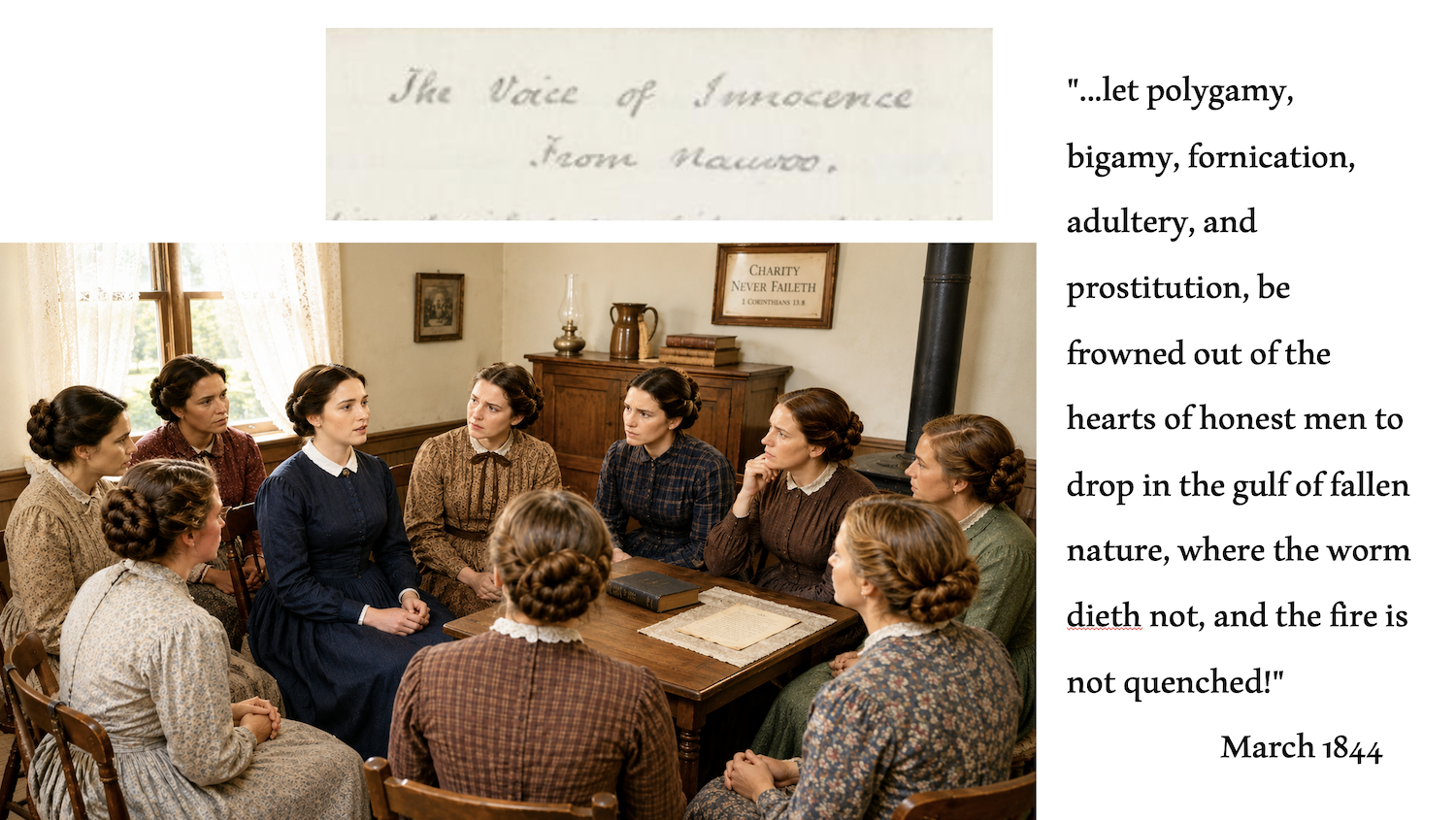
TEACHER: Well, here’s something related to Joseph and others who opposed multiple wives. The Relief Society sisters were encouraged to be on guard and oppose anyone claiming that any type of questionable sexual behavior came from Joseph. Beginning on March 9, 1844, Emma read this to four overflowing crowds where it was sustained. Yes, Mary!
(class mumbling)
MARY: Emma lacked faith and opposed plural marriage. So, this document was a way for her to encourage everyone to follow what Joseph was saying publicly. But we know that privately Joseph and a few select followers were living plural marriage. And when Joseph and others used the terms “polygamy” or “spiritual wifery” they were referring to the efforts of impostors. Those imposters were imitating the divinely restored plural marriage doctrine and they were trying to seduce women.
(class mumbling)
TEACHER: It certainly resulted in confusion, and it had to be MORALLY exhausting for Joseph and that inner circle to publicly denounce something they were privately living. I do know the name “plural marriage” was NOT used until the Utah era, the 1850s onward. I believe, these women were on guard against anything outside the boundaries of monogamous marriage, no matter what it was called.
“Inasmuch as this Church of Christ has been reproached with the crime of fornication and polygamy, we declare that we believe that one man should have one wife, and one woman but one husband, except in the case of death, when either is at liberty to marry again.”
To add to the confusion Section 101 of the 1835 edition of the D&C forbade polygamy. Can someone read this screen? Meg!
(Meg reads)

This is from the Joseph Smith Papers Project. It’s a copy of Section 101 from the 1835 edition that Meg just read. Shortly after the prophet's martyrdom in 1844, the wording remained unchanged and became Section 109 in the 1844 edition. So Joseph was aware of this section forbidding polygamy up until his death.
(class mumbling)
TEACHER: The polygamy revelation was not made public until the Saints were securely settled in Utah, far from other major cities and people who were not of their faith. Then, Elder Orson Pratt, under the direction of President Brigham Young, announced the revelation at a Church conference in 1852. Yes, Doug!
DOUG: I’ve read Orson Pratt’s sermon. It is inspiring to hear this announcement publicly restoring this ancient, exalting principle. I believe the Lord prepared the early saints by leading them out west, where they were isolated, with little outside influence to interfere as they lived this commandment.
BETH: Yep, harder to escape.
(class laughs)
TEACHER: Perhaps. Interestingly, the Section forbidding more than one wife stayed in the D&C for another 24 years until 1876. It was removed when the plural marriage revelation was placed in the Doctrine and Covenants as Section 132. Yes, Sam!
SAM: I know they didn’t have digital scriptures, so they couldn’t cheaply and easily delete a section, but I don’t get why they were practicing plural marriage for almost 40 years while there was a section in their scriptures calling it a crime.
TEACHER: Yes. It is confusing.
Introductory Verses
“1 Verily, thus saith the Lord unto you my servant Joseph, that inasmuch as you have inquired of my hand to know and understand wherein I, the Lord, justified my servants Abraham, Isaac, and Jacob, as also Moses, David and Solomon, my servants, as touching the principle and doctrine of their having many wives and concubines—
2 Behold, and lo, I am the Lord thy God, and will answer thee as touching this matter.
3 Therefore, prepare thy heart to receive and obey the instructions which I am about to give unto you; for all those who have this law revealed unto them must obey the same.
4 For behold, I reveal unto you a new and an everlasting covenant; and if ye abide not that covenant, then are ye damned; for no one can reject this covenant and be permitted to enter into my glory.”
Let’s look at the first four verses of Section 132.
The first verse gives us the actual name of the doctrine: “the principle and doctrine of having many wives and concubines.” We focus on having many wives but ignore the concubines.
Throughout history, concubines have generally been a way for men to have sexual access to women without the usual obligations of marriage. Israel occasionally participated in the broader pagan custom of concubinage common in the ancient Near East. Elder Bruce R. McConkie referred to them as “secondary wives”. Yes, Mary!
MARY: I find it meaningful that concubines are elevated to the status of being mentioned in this revelation.
TEACHER: That’s one way to look at it. I, frankly, don’t understand why they are mentioned at all because this is about multiple wives in the 1800s and the eternities. There were no concubines in the United States in the 1800s. And I can’t see how women would continue to have a lower status in a heavenly kingdom, where we should ALL be equal.
Of course, eternal multiple wives is also a challenge to understand because that’s not equality either. How could it be if it takes many wives to equal one man? Yes, Beth!
BETH: The first verse starts with a contradiction. Not all of these Old Testament leaders had more than one wife, and NONE of these men were commanded by God to have additional wives. The Old Testament tells their stories, never says God commanded polygamy, and never describes it favorably. Even though that first verse says God justified having multiple wives, as you all know, I don’t believe He did.
TEACHER: Yes, it has been said that the Old Testament is descriptive, rather than prescriptive. But Section 132 IS prescriptive, with God prescribing this principle. In fact, not only does He command multiple wives in Section 132—which my reading also shows is the only place in scripture where it is commanded—but he lets us know in verse 4 that if we don’t live this principle, we will be damned. Yes, Doug.
DOUG: I think it’s important to remember that it was sometimes part of the Old Testament way of life, and this is part of the restoration of all things. They may not have lived plural marriage perfectly, and it may have resulted in some hardships and messed-up families, but we live in a fallen world.
TEACHER: Okay. Meg!
MEG: If it says we will be damned for not living this principle, why aren’t we living it now? Not that I want to live it!
(class laughs)
TEACHER: Well, in 1890, President Wilford Woodruff received a revelation that ended the practice. That’s the Official Declaration 1 in your D&C. Then, in 1904, President Joseph F. Smith issued a second statement reaffirming the Church's opposition.
We’re taught that modern prophets outweigh what is in scripture and that subsequent prophets outweigh earlier prophets. We, of course, still have Section 132 as an eternal principle. And keep in mind that NO modern prophet has said it is NOT an eternal principle. Yes, Meg!
MEG: I’m confused. I thought this section was about eternal marriage. Why do you think that ALL of this Section is about many wives and concubines?
TEACHER: Well, it is about eternal marriage, but this section deals with eternal, plural marriage. Look at these verses. In verse one, the Lord is telling Joseph, “You have inquired about how Old Testament men could be justified in having many wives and concubines.” Then there’s a dash telling us the thought will continue. In verse two, the Lord says he will answer this matter. In verse three, he warns Joseph to prepare and obey what he’s going to reveal. Then in verse four, the Lord reveals how He justifies many wives and concubines through the new and everlasting covenant.
(class mumbles)
This is my opinion, and the Institute manual disagrees. The Institute manual says that verses 3-33 deal with Celestial marriage, and the rest of the verses deal with plural marriage. However, these first four verses are like a thesis statement telling me what ALL of this Section is about, at least the way we have Section 132 today. This document answers how to justify many wives…and concubines!
SAM: How do we know verse 4 is referring to plural marriage? It doesn’t mention plural marriage or many wives.
TEACHER: I’m ahead of you, Sam. The answer is on my next slide….
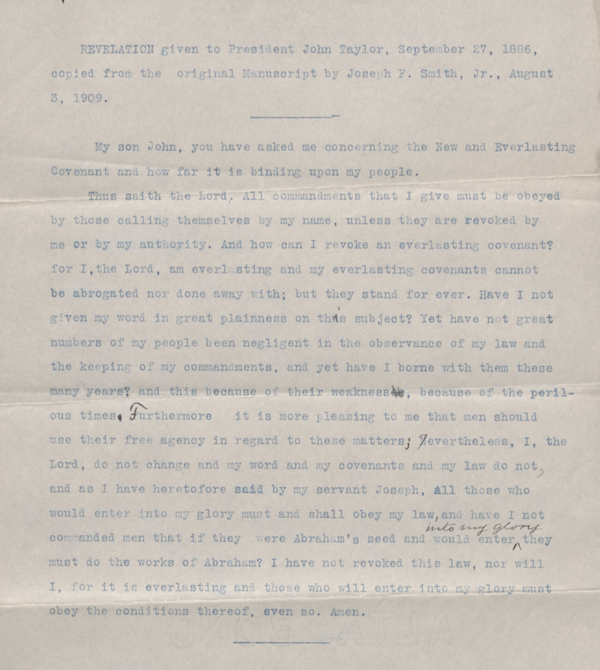
John Taylor revelation, 1886 September 27
“My son John. you have asked me concerning the new & everlasting covenant and how far it is binding upon my people”
This is the 1886 John Taylor revelation that appeared on the Church’s website last year. From this, we know that in the early church, the new and everlasting covenant referred to plural marriage. In this document, John Taylor repeats some of what is in Section 132 and, without even using the word "marriage" and by using only the phrase "new and everlasting covenant," conveys that the principle of having many wives and concubines is an eternal principle that should never leave the earth.
(class mumbles)
This 1886 revelation is like a Rosetta Stone, helping us decipher and verify the original meaning of this phrase. The new and everlasting covenant meant plural marriage.
“And as pertaining to the new and everlasting covenant, it was instituted for the fulness of my glory; and he that receiveth a fulness thereof must and shall abide the law, or he shall be damned, saith the Lord God.”
Knowing the meaning of that phrase gives special significance to verse 6, which repeats what we were told in verse 4, we are damned if we don’t abide by this covenant or law: the new and everlasting covenant.
Yes, Mary! Then Sam!
MARY: But we know today from current Church leaders that the New & Everlasting Covenant is the fullness of the gospel, which includes eternal marriage. I do agree, though, that back then and in Section 132, the new and everlasting covenant was plural marriage. It’s clear that it was given for God’s glory, and we must obey it.
SAM: This should make us less judgmental of our polygamist neighbors. I understand why they believe they must obey this law. They are following the same scriptures we do. The only difference is that they discount the later manifestos that temporarily ended it.
Requirements for Eternal Marriage
TEACHER: I agree.
Verses 7-8 and verses 15-21 set forth details about the law and not specifically many wives and concubines, which is probably why the Institute manual says that verses 3-33 deal with Celestial marriage, and not plural marriage. But as I explained, I see the first 4 verses as a thesis statement. The whole essay is on how to justify many wives and concubines.
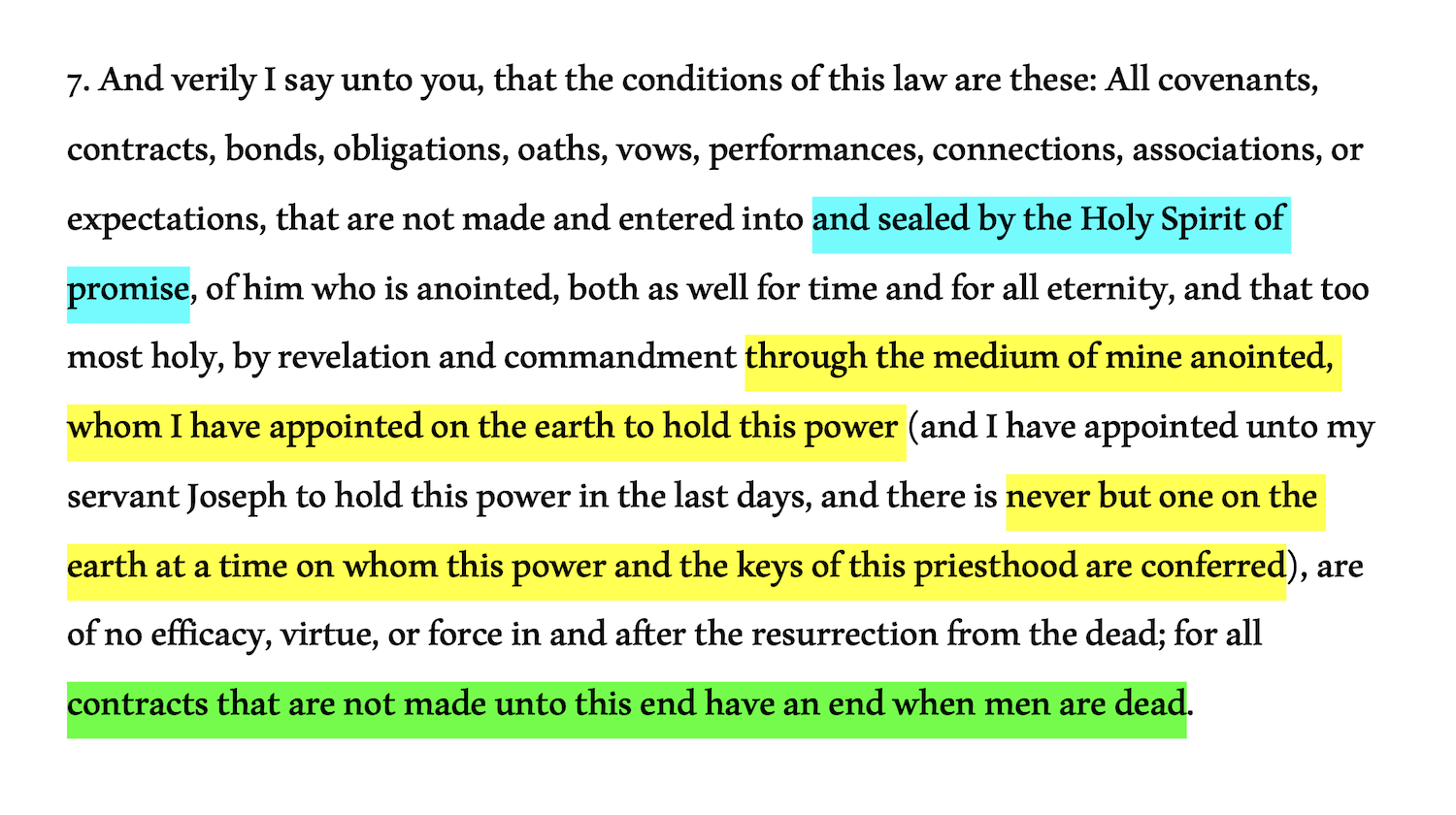
And verse 7 gives a significant overview of what is in verses 13-21. Verse 19 repeats these requirements, but I think verse 7 is clearer, so I went with this verse. We learn that:
· Any kind of marriage agreement is temporary unless a covenant is made, that’s highlighted in green.
· It must be sealed by the Holy Spirit of Promise, highlighted in turquoise.
· And sealed by one man on earth at a time with the authority, highlighted in yellow.
This is how we get eternal marriage and, specifically, because we are in Section 132, eternal plural marriage.
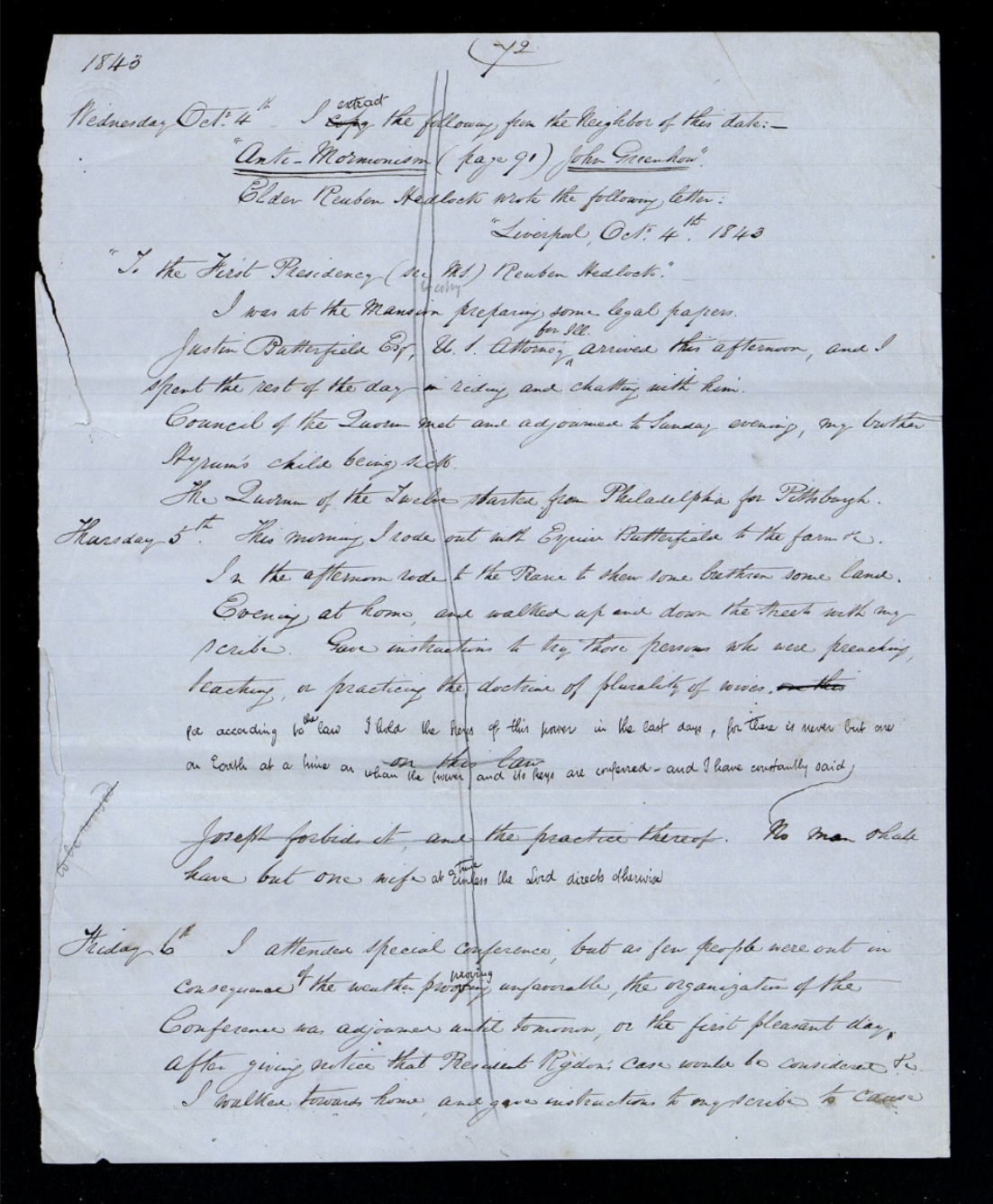
“… Joseph forbids it. and the practice thereof—No man shall have but one wife.”
After Joseph’s death, it was changed to:
“according to the law I hold the keys of this power in the last days, for there is never but one on Earth at a time on whom the power and its keys are conferred— and I have constantly said no man shall have but one wife at a time, unless the Lord directs otherwise.”
I don’t want to get bogged down with the history—our focus is this section—but I’m showing this slide because it is related to the requirements of an eternal plural marriage from verse 7. This slide shows that we can view some of the alterations to the History of the Church that are on the Joseph Smith Papers website. Yes, Doug!
DOUG: I think we get an accurate, overall idea of the history from Saints, The Standard of Truth.
TEACHER: I don’t know. In some cases. But this is one small example of something they don’t consider or explain in Saints.
In this October 5, 1843, journal entry, Willard Richards wrote Joseph’s words, which said Joseph forbids polygamy and no man shall have but one wife. After his death, Joseph’s words were changed to say that sometimes god directs more than one wife. Also added was that one on earth at a time holds this power and the keys, which is one of the requirements for an eternal plural marriage that we just read in verse 7.
(class mumbles)
From the explanation on the Joseph Smith Papers website, these changes occurred at least 10 years after Joseph’s death. And they made it into the Manuscript History of the Church, into D&C 132, and into Saints.
Now, one thing implied in those Oct 5 changes is the wording that monogamy is the standard unless the Lord directs otherwise. I don’t see that in Section 132, but the church uses that wording often when describing plural marriage.
Yes, Sam, then Doug!
DOUG: President Young oversaw many changes because Joseph was killed without the chance to review what was written. And Joseph didn’t write everything down. In fact, if you tour the nearby St George Brigham Young house, they tell you that the endowment was never written down in Nauvoo, so Brigham and Willard Richards had to write it based on their memory of Joseph’s words.
I don’t think we can use this entry to question whether Joseph originally taught plural marriage. Joseph had to say one thing in public, and another in private. The fact that his words were altered to align with Section 132 shows the inspiration of subsequent leaders.
BETH: Or it shows that in a vacuum created by the absence of godly leadership, sin seeps in, fills the void, and, after Joseph’s death, they had to cover their tracks.
(class laughs)
SAM: So you’re saying this altered wording, saying more than wife is okay when someone with the power says it’s okay, is in Section 132?
TEACHER: Yes, maybe not the exact wording. Let me go back. (She shows the slide of verse 7) It’s the wording highlighted in yellow. And that phrase “never but one on Earth at a time on whom the power and its keys are conferred” is the exact wording in verse 7. I’m learning too. I didn’t realize that.
(class laughs)
Moving on. I don’t have a slide, but you can see in your scriptures that verses 15-21 say that those who don’t marry in God’s way will be single servants to those who do. Those who do it the right way will be gods with all power. How do you feel knowing this?
DOUG: I want to marry the right way so I can have power!
(class laughs)
SAM: There’s humor in that, but also real harm.
Christ gave us two great commandments, and one of them was to love our neighbor as ourselves. But much of Section 132—and the doctrine that has grown out of it—seems to feed a sense of superiority rather than equality.
After all, men hold the power and can take multiple wives. As a man, that doctrine could easily teach me that I have far more value than a woman, because one man is treated as equal to many women.
We saw a similar kind of harm when the Church taught that Black members could not hold the priesthood. That teaching fed a sense of superiority in the rest of us, because we believed God saw us as more worthy.
I’m not sure any of this helps us love others as equals, the way Christ asked us to.
The Works of Abraham
TEACHER: That’s something important to consider, Sam.
“32 Go ye, therefore, and do the works of Abraham; enter ye into my law and ye shall be saved.
33 But if ye enter not into my law ye cannot receive the promise of my Father, which he made unto Abraham.
34 God commanded Abraham, and Sarah gave Hagar to Abraham to wife. And why did she do it? Because this was the law; and from Hagar sprang many people. This, therefore, was fulfilling, among other things, the promises.
35 Was Abraham, therefore, under condemnation? Verily I say unto you, Nay; for I, the Lord, commanded it.”
These are important verses. This is where we are again told that the law, which is the new and everlasting covenant, which is plural marriage, is required. It’s what caused Sarah, before God’s covenant, when she was called Sarai, to give Hagar to Abram. Yes, Mary!
MARY: Sisters, I know that if we want the blessings of Abraham, someday we will need to “do the works of Abraham” and obey this law.
TEACHER: Beth!
BETH: Verse 34 states something that is NOT in the Bible. Where in the Bible did God command this? Sarai didn’t trust God’s promise and used her slave to get a child. Section 132 gives, takes, threatens with destruction, women who will not comply. This supposed law is how some of the worst offenders, like Warren Jeffs, persuaded their wives to sacrifice young girls for this purpose. There’s a new documentary about Samuel Bateman, who did the same thing. For me, anyway, the lesson is that God’s people must stay on guard against Satan’s corrupting schemes—and this doctrine was one of those corrupting schemes.
MARY: Beth, God’s laws aren’t always easy.
BETH: God’s laws may not be easy, but they are also not immoral or harmful. The exploitation of innocent young girls or, frankly, any woman threatened with destruction if she doesn’t go along with being used sexually is sexual coercion. What Abraham did by accepting Hagar from Sarah is never described as righteousness in the Bible.
“36 Abraham was commanded to offer his son Isaac; nevertheless, it was written: Thou shalt not kill. Abraham, however, did not refuse, and it was accounted unto him for righteousness.
37 Abraham received concubines, and they bore him children; and it was accounted unto him for righteousness, because they were given unto him, and he abode in my law; as Isaac also and Jacob did none other things than that which they were commanded; and because they did none other things than that which they were commanded, they have entered into their exaltation, according to the promises, and sit upon thrones, and are not angels but are gods.”
TEACHER: Well, that ties right in. The Bible may not say it was righteous, but Section 132 does. We can see in this verse that Abraham received concubines, and it WAS accounted unto him for righteousness. It’s compared to the obedience of being willing to sacrifice Isaac. Of course, God NEVER intended the sacrifice of Isaac—he hates human sacrifice— but the plural marriage sacrifice, he apparently loves—at least based on this Section.
(class murmurs)
In Section 132, women are, in a sense, sacrificed in this life and eternally.
Adultery for Some
“41 And as ye have asked concerning adultery, verily, verily, I say unto you, if a man receiveth a wife in the new and everlasting covenant, and if she be with another man, and I have not appointed unto her by the holy anointing, she hath committed adultery and shall be destroyed.
42 If she be not in the new and everlasting covenant, and she be with another man, she has committed adultery.
43 And if her husband be with another woman, and he was under a vow, he hath broken his vow and hath committed adultery.
44 And if she hath not committed adultery, but is innocent and hath not broken her vow, and she knoweth it, and I reveal it unto you, my servant Joseph, then shall you have power, by the power of my Holy Priesthood, to take her and give her unto him that hath not committed adultery but hath been faithful; for he shall be made ruler over many.”
TEACHER: These next verses touch on adultery. If a woman does not commit adultery, but her husband does, God, in His mercy, allows her to be given to another worthy man. How do you feel knowing that God has provided a way for a woman who has suffered through a bad marriage to be blessed with a worthy man? Yes, Beth, I figured you’d have a comment.
BETH: : If this meant an exclusive godly, covenant relationship, that we be great. But since this likely means that she will become a plural wife, sharing her husband with other women, I don’t see the blessing. The woman who suffered with an adulterous husband would experience the same trauma, only worse. Now she would suffer through what would be considered god-approved adultery.
Verse 41 states that a woman who commits adultery under the “new and everlasting covenant” will be destroyed, while the following verses seem to imply different consequences when that covenant is not involved. Yet the text then describes a “non-adulterous” woman as someone who can be “taken” and “given.” The wording gives little sense of female agency or consent. Instead, the woman functions more like property being transferred between men. We have a term for that today: human sex trafficking.
Emma
“51 Verily, I say unto you: A commandment I give unto mine handmaid, Emma Smith, your wife, whom I have given unto you, that she stay herself and partake not of that which I commanded you to offer unto her; for I did it, saith the Lord, to prove you all, as I did Abraham, and that I might require an offering at your hand, by covenant and sacrifice.
52 And let mine handmaid, Emma Smith, receive all those that have been given unto my servant Joseph, and who are virtuous and pure before me; and those who are not pure, and have said they were pure, shall be destroyed, saith the Lord God.
53 For I am the Lord thy God, and ye shall obey my voice; and I give unto my servant Joseph that he shall be made ruler over many things; for he hath been faithful over a few things, and from henceforth I will strengthen him.
54 And I command mine handmaid, Emma Smith, to abide and cleave unto my servant Joseph, and to none else. But if she will not abide this commandment she shall be destroyed, saith the Lord; for I am the Lord thy God, and will destroy her if she abide not in my law.”
TEACHER: You get right to the point, Beth! Let’s look at Emma’s situation. Maybe we’ll gain some insights. She was told not to partake of something…we’re not sure what that was. Yes, Doug!
DOUG: At one point, she was told by God through Joseph that she could marry other husbands, as Joseph was marrying other wives. But in verse 51, we see that God rescinded that offer. Of course, only men can marry plurally.
TEACHER: Thank you, Doug. The institute manual says, “No indication is given here or elsewhere of what the Lord had commanded the Prophet Joseph to offer to his wife, but the context seems to suggest that it was a special test of faith similar to the test of Abraham’s faith when the Lord commanded him to sacrifice Isaac. Beyond that, it is useless to speculate.”
So we won’t speculate, but we do know that, according to these verses, Emma is to receive the other wives…at least the virtuous and pure ones. The others will be destroyed anyway, so I guess she didn’t have to worry about those wives.
(class laughs)
She needs to cleave to her husband and abide by the law of having many wives and concubines. Yes, Beth, then Meg!
BETH: This is the only passage in scripture where a wife is specifically told to cleave to her husband, which is contradictory because Emma was expected to be one of many wives. Throughout scripture, the repeated pattern is God’s original design: a man leaves his father and mother and cleaves to his one wife, and the two become “one flesh.” When a husband is divided among many wives, he does not follow God’s marriage design.
TEACHER: Thank you. Meg!
MEG: So Emma will be destroyed if she doesn’t cleave to a husband who is commanded to cheat on her? I’m beginning to understand why this section was never covered in Sunday School, and why some women are so traumatized by it.
BETH: God’s commandments are meant to bless us and be for our good. When we ignore His guidance, there are often consequences.
I can’t prove a direct connection, but I wonder whether there’s a reason Utah ranks so high in certain troubling categories, including pornography use, cosmetic surgery, antidepressant use, and human trafficking! I also saw statistics placing Utah relatively high in reports of child sexual abuse. To me, these patterns raise difficult questions worth considering.
Polygamy fostered a culture that kept men looking for the next conquest and kept women in competition with each other. I think teaching that “this is an eternal principle” continues to hurt men, women, and their marriages and families.
MARY: The high trafficking statistic is probably related to the large numbers of polygamists’ sects in Utah.
BETH: Exactly my point. The lifestyle has consequences.
MARY: Ok, well I don’t see how abuse can be tied to the Church. Other churches have had huge scandals related to sexual abuse. Remember the catholic clergy who covered up the abuse of altar boys?
BETH: Yes, many churches struggle with abuse within their ranks. But they do not place abuse within their scriptural canon. WE DO. Only Section 132 makes the UNHOLY treatment of women and girls a doctrine that comes from God. We are unique among other Christian churches.
And, in a troubling way, we are even unique among polygamous systems. Polygamy has existed throughout history and continues in parts of the world today, and statistics show that it has negative outcomes. Again, there are consequences for sin.
But the polygamy in Section 132 is far worse. This is not simply consenting adults choosing a difficult marriage arrangement; this is GOD commanding this marriage arrangement. God is commanding a system where women and minor girls are taught that refusal brings divine destruction. Where their example is a slave forced to have sex to produce a child for her mistress.
We are not only responsible for our actions, but also for the ideas and systems we justify. Some practices may have existed in the ancient world, but we are still accountable for what we choose to call righteous today.
(class mumbles)
TEACHER: Thank you, Mary and Beth, for that enlightening exchange.
Lots of Virgins
“61 And again, as pertaining to the law of the priesthood—if any man espouse a virgin, and desire to espouse another, and the first give her consent, and if he espouse the second, and they are virgins, and have vowed to no other man, then is he justified; he cannot commit adultery for they are given unto him; for he cannot commit adultery with that that belongeth unto him and to no one else.
62 And if he have ten virgins given unto him by this law, he cannot commit adultery, for they belong to him, and they are given unto him; therefore is he justified.”
TEACHER: Alright. These next verses are important. Can I have someone read them? Doug!
(Doug reads)
DOUG: Let me add that God, who of course perfectly understands male nature, has provided a way for a man who desires another woman. Of course, to be righteous and justified, the criteria must be met. There must be a covenant, under the holy spirit of promise, by one with authority.
BETH: I wonder, Doug, God does perfectly understand male nature, and His scriptures often refer to the natural man as an enemy to God. Sin is a pervasive and persistent part of fallen human nature—we are all sinners. Perhaps the desire for another woman is part of that sinful nature, not something to indulge, but something to fight and overcome.
“But if one or either of the ten virgins, after she is espoused, shall be with another man, she has committed adultery, and shall be destroyed; for they are given unto him to multiply and replenish the earth, according to my commandment, and to fulfil the promise which was given by my Father before the foundation of the world, and for their exaltation in the eternal worlds, that they may bear the souls of men; for herein is the work of my Father continued, that he may be glorified.”
TEACHER: That’s something to consider. Here’s the next verse. We’re told that if these virgins have relationships with other men, they have committed adultery and will be destroyed. Yes, Doug!
DOUG: This is the verse that explains why Emma could not enter plural marriage herself and marry other husbands. Women are given to men to multiply and replenish the earth.
TEACHER: Perhaps. With multiple wives, one man may father more children himself; however, there are fewer children overall, so it doesn’t accomplish that purpose. Maybe that’s why Adam, Noah, Lehi, and their families all had one wife. They had a better chance of producing more children for the new societies.
Although that wasn’t the objective anyway, Jacob chapter 2 in the Book of Mormon presents monogamy as God’s pattern for raising a righteous “branch” or “seed.” The emphasis is on quality—righteousness and faithfulness—not quantity. Polygamy is condemned as an abomination before God.
DOUG: Jacob 2:30 says sometimes it is commanded.
BETH: Not if you read that verse in context, Doug.
DOUG: Either way, monogamy was a commandment only given to Lehi’s people at that time.
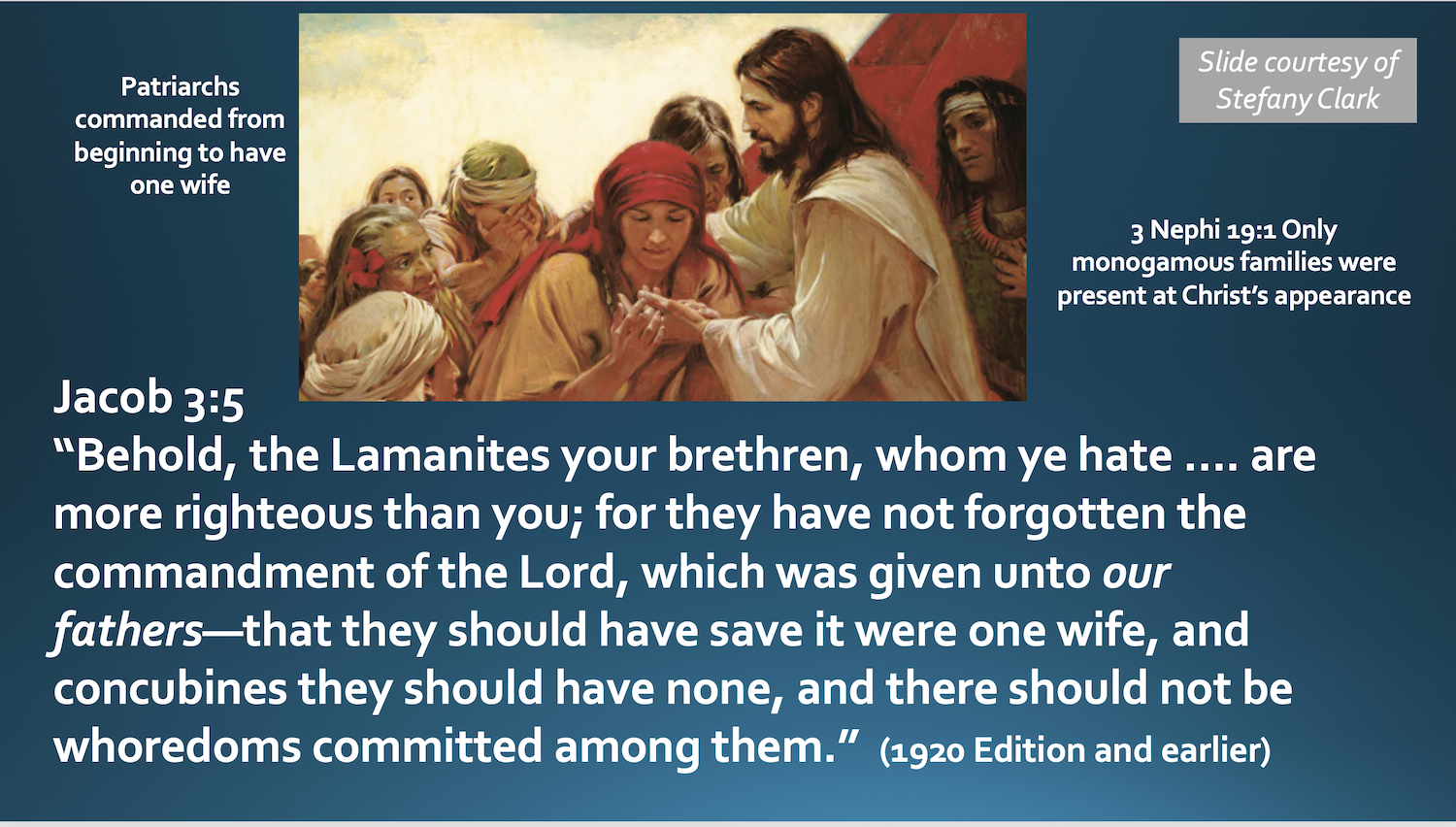
Law of Sarah
TEACHER: This next slide hits on that exact point. A friend of mine, Stefany Clark, taught Section 132 in her ward last year and shared her slides with me.
Doug, editions of the Book of Mormon after 1920 changed the plural word fathers to the singular father. That is sometimes used to say it was a commandment only for the patriarch, Lehi, rather than a broader group. But if we go with the earlier editions, it was a commandment for all the Patriarchs.
Also, Doug, in verse 31 of Jacob 2, the Lord says that because their husbands have many wives, He has heard the mourning of His daughters in ALL the lands of His people, not just in the land where Lehi lived.
“64 And again, verily, verily, I say unto you, if any man have a wife, who holds the keys of this power, and he teaches unto her the law of my priesthood, as pertaining to these things, then shall she believe and administer unto him, or she shall be destroyed, saith the Lord your God; for I will destroy her; for I will magnify my name upon all those who receive and abide in my law.
65 Therefore, it shall be lawful in me, if she receive not this law, for him to receive all things whatsoever I, the Lord his God, will give unto him, because she did not believe and administer unto him according to my word; and she then becomes the transgressor; and he is exempt from the law of Sarah, who administered unto Abraham according to the law when I commanded Abraham to take Hagar to wife.”
Moving on with the doctrine…I’ll read these verses.
(teacher reads)
This explains the law of Sarah. Sarah, or Sarai, gave Hagar to Abram so she could have a child. Troubling as it is, a wife needs to be prepared to do that for her husband under the new and everlasting covenant. Remember verse 61 says the first wife needs to give consent for more wives, but if a wife doesn’t live the law of Sarah by bringing other wives, then, according to verse 65, her consent is no longer necessary. Any comments? Yes, Meg, then Sam!
MEG: I am stunned by this. A plural wife has to find other sexual partners for her husband? Women tend to trust other women, so the earlier wives were being used as… lures to entice other women? The men were weaponizing trust—using these women as a means to gain access or credibility with new targets. I mean, I can’t judge these first wives, though. They are being manipulated themselves by believing they are obeying God.
SAM: I didn’t know what was in this section, either. Do our teenagers ever read this section? I hope not! I have enough challenges with my teenage son; I don’t want him to consider the possibility of many wives. And I especially don’t want my daughter to learn that she can be used like this. I cringe thinking of my sweet 12-year-old hearing this…and my wife also. It makes me sick. It’s dehumanizing. Marriage is not all about sex, but the way plural marriage is presented in Section 132, it is only about sex. Women are for reproduction alone, to be used by men, and to be destroyed if they don’t go along with it. This is not a healthy message.
BETH: Thank you, Sam, for being a man willing to stand up and protect women. I’m sure every man in this room would defend a woman being physically assaulted. Section 132 assaults women verbally and spiritually. Yet many men do not recognize this evil and simply stand by while women are dehumanized and threatened.
That may be why even men who believe plural marriage is divine often feel the need to apologize for that belief. But apologies are not enough. They should also speak up to protect women from this dangerous doctrine.
Sam, you mentioned that plural marriage in Section 132 is presented largely as being about sex. For too many early Church plural wives, that was the extent of the relationship: being impregnated, with little meaningful companionship beyond that. When you tour Brigham Young’s St. George home, you learn that his favorite wife—37 years younger than he was—traveled with him and spent winters with him in St. George as he aged. He had 55 other wives. What kind of relationship could most of those women realistically have had with their husband?
TEACHER: Thank you Beth. Meg!
MEG: Did the primary children get this lesson?
TEACHER: The primary children did hear the plural marriage lesson last year. I’m pretty certain it was nothing like this lesson, though.
(class laughs).
It did present the idea that God SOMETIMES commands more than one wife.
MARY: Sorry, but despite all this, I need to share my testimony that I still know the plural marriage principle is holy.
DOUG: Amen! I agree, but I also feel I need to apologize for being a man! Sorry!!
(Class laughs)
Conclusion
TEACHER: Time’s up, and I probably need to apologize, too. I’m sorry if this has been upsetting for some of you. However, I can’t apologize for what is in Section 132 because I didn’t write it. And, like all of our scriptures, we need to know what is in them. Yes, Beth? This is the last comment!
BETH: I was reading Romans 1 this week, where Paul uses the phrase “God gave them over” three times. God allows people who persistently reject His way to go their own way.
Any sexual relationship outside the godly covenant of marriage is adultery. But that is not what we see when marriage is viewed through the lens of Section 132. Instead, relationships that would otherwise be adultery are made acceptable simply by calling them plural marriage.
So what I wanted to say related to Romans 1: I believe that in Section 132, we have exchanged the truth of God for a lie.
Teacher: Thank you, Beth. On that note, let’s have the closing prayer.