Scriptures Through a Polygamy Lens

Some people point to examples of multiple wives in the Old Testament to justify setting aside God’s original design for marriage. But Jacob chapter 2 directly challenges that approach, warning that:
"...they understand not the scriptures, for they seek to excuse themselves in committing whoredoms, because of the things which were written concerning David, and Solomon his son."
The Come, Follow Me manual reminds us that…
“…some gospel truths are stated plainly, while others are taught through stories.”
That raises a question about polygamy-related verses. Are they instructive or cautionary? Should doctrine come from isolated verses, or from the overall message of scripture? With that in mind, I want to look at several passages—some used to oppose polygamy, and others used to support it.
Cleave to Your One Wife
I’ll start with an easy one that, in my opinion, send the message that God does not approve of this practice. This verse clearly outlines God's ideal for marriage: one man with one woman. It appears 4 times in the Bible and a total of 7 times in LDS scriptures. This may be a coincidence, but in the Bible, the number 7 often represents completion or spiritual perfection. Isn’t it interesting that LDS believers are given this verse seven times?
It appears first in Genesis 2:24 and is spoken by Adam, who lays out the clear purpose of this relationship.
“Therefore shall a man leave his father and his mother, and shall cleave unto his wife: and they shall be one flesh.”
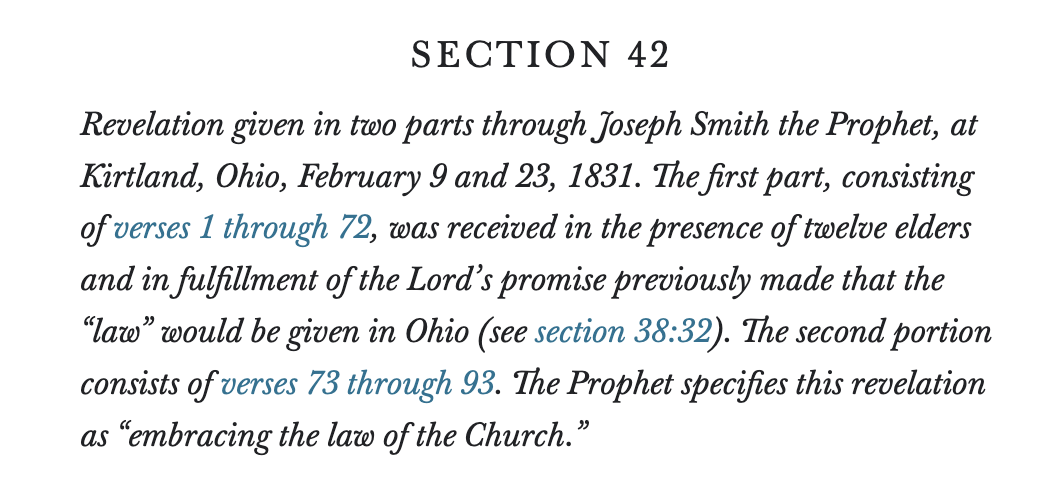
It shows up in the Doctrine and Covenants, in Section 42. As the heading explains, Section 42 is the fulfillment of the Lord’s earlier promise that His law would be given to the Church in Ohio. In other words, what follows isn’t commentary—it’s presented as God’s law.
And right there, in verse 22, the command is unmistakable: one man, one wife. What’s ironic is that this command appears in the same book that later contains Section 132. And the two sections could not be more opposed to each other. Based on the understanding of Section 132, I see it as a highly coercive text—one that dictates the sexual use of women as plural wives, without their input or consent.
That tension matters. Because if Section 42 reflects God’s law on marriage, then Section 132 stands out—not as a continuation of that law, but as a contradiction to it.
In the New Testament, we read of Pharisees attempting to trap Jesus with a question about divorce. Jesus’s answer is recorded in Matthew 19:5 and Mark 10:7-8:
“But from the beginning of the creation God made them male and female. For this cause shall a man leave his father and mother, and cleave to his wife; And they twain shall be one flesh: so then they are no more twain, but one flesh.”
The Savior often pointed back to His word, the Old Testament, not the scribes’ interpretations of His word (scriptures or conference talks?) In this case, he confirms the original, divine establishment of marriage. So, how does a polygamy advocate explain this scripture? How would cleaving unto multiple wives work in a plural marriage?

A picture, especially with a good caption, is worth a thousand words. Karen Hyatt, with the help of AI, gets credit for this. (josephtoldthetruth.org).
Podcaster Greg Matson has argued that plural marriage is really plural marriages—because a man marries one woman at a time, not all at once. By that logic, cleaving to “none else” could mean cleaving to a different woman each night.
Mathematically, I don’t think that works.
God’s design is one man cleaving to one wife—not rotating intimacy. The idea of cleaving addresses loneliness and unity, and that requires two people giving themselves fully to each other. A man cannot give one hundred percent when there are multiple wives, even if he married them separately.
And if “cleaving to one” means anything at all, it means the same woman all of the time.
So how do some override this verse—that appears SEVEN times in scripture?
The comments of Zina Huntington can be used to discount a woman’s desire for a husband who cleaves to her. Zina’s solution is to keep expectations very low and regard a husband with indifference.
“A successful polygamous wife “must regard her husband with indifference…” Zina Huntington
From a male polygamist’s perspective, Brigham Young also provided the antidote to the cleaving commandment:
“Sisters, do you wish to make yourselves happy? Then what is your duty? It is for you to bear children... are you tormenting yourselves by thinking that your husbands do not love you? I would not care whether they loved a particle or not; but I would cry out, like one of old, in the joy of my heart, ‘I have got a man from the Lord! Hallelujah! I am a mother...’ ”
Prophet Brigham Young, Journal of Discourses, v. 9, p. 37
Brother Brigham’s message comes through loud and clear: Sisters, your primary concern is to secure a man who will impregnate you! By implication, his statement reduces a man’s obligation to reproduction alone. Brigham’s framing ignores the seven scriptural admonitions to cleave to one wife. However, it aligns closely with the logic of Section 132, whose message is not to cleave to one woman; rather, the sexual use of multiple women, and since their consent is not necessary, it follows the precedent imposed on Hagar.
After hearing a survivor of sexual assault speak on a Faith Matters podcast, my understanding of this text changed. I now believe that Doctrine and Covenants 132 metaphorically puts a gun to women’s heads—threatening their salvation while dictating how their bodies are to be used sexually.
Wives Given by God?
Some people point to 2 Samuel 12:7-8 and say, “See? God sanctioned polygamy.” But once you actually look at the passage, that claim doesn’t hold up.
And Nathan said to David, Thou art the man. Thus saith the Lord God of Israel, I anointed thee king over Israel, and I delivered thee out of the hand of Saul. And I gave thee thy master's house, and thy master's wives into thy bosom, and gave thee the house of Israel and of Judah; and if that had been too little, I would moreover have given unto thee such and such things.
David had committed adultery with Bathsheba and brought about her husband’s death. At that point, David had made Bathsheba his wife and had seemingly gotten away with his sin, but the Lord knew about it and told Nathan to rebuke David.
Nathan went to David and wisely told the king a fable about a rich man and a poor man: the rich man was visited by a traveler, so he took the poor man’s only possession, a little ewe lamb that he loved as a pet, to feed his guest, rather than taking a lamb from his own extensive flocks. David was enraged at the story and declared that the rich man had no pity and deserved to die. Nathan then points to David and says, “You are the man!” Nathan reveals that David’s sin was like that of the rich man, because David took away Uriah’s wife.
Nathan then prophesies to David, in God’s own words: “I anointed you king over Israel, and I delivered you out of the hand of Saul. And I gave you your master’s house and your master’s wives into your arms and gave you the house of Israel and of Judah. And if this were too little, I would add to you as much more. Why have you despised the word of the LORD, to do what is evil in his sight?”
In the ancient world, that language wasn’t about marriage or sex. It was about royal succession. When a king died, his household—all his stuff, including his wives—passed to the next king as part of the throne and its authority.
In fact, former kings’ wives were often killed to prevent rival heirs. David had promised not to harm Saul’s family, so God’s “giving” these women to David meant that he protected them and provided for them.
And here’s the key point: The Bible never says David married these women. It never says he had sexual relations with them.
So when God says, “If that had been too little, I would have given you more,” do we think God is referring to more ladies to hook up with? No. Nathan’s point is the opposite: David already had everything. Power. Protection. Privilege. And he still wasn’t content.
And remember—God had already warned Israel that a king must not “multiply wives.” Yet powerful men ignored that warning, using polygamy to feed pride, desire, and control. In Deuteronomy 17:17, it says:
Neither shall he multiply wives to himself, that his heart turn not away: neither shall he greatly multiply to himself silver and gold.
Look at the pattern. Stephany Clark compiled a list—using AI—of the most brutal polygamists in history.
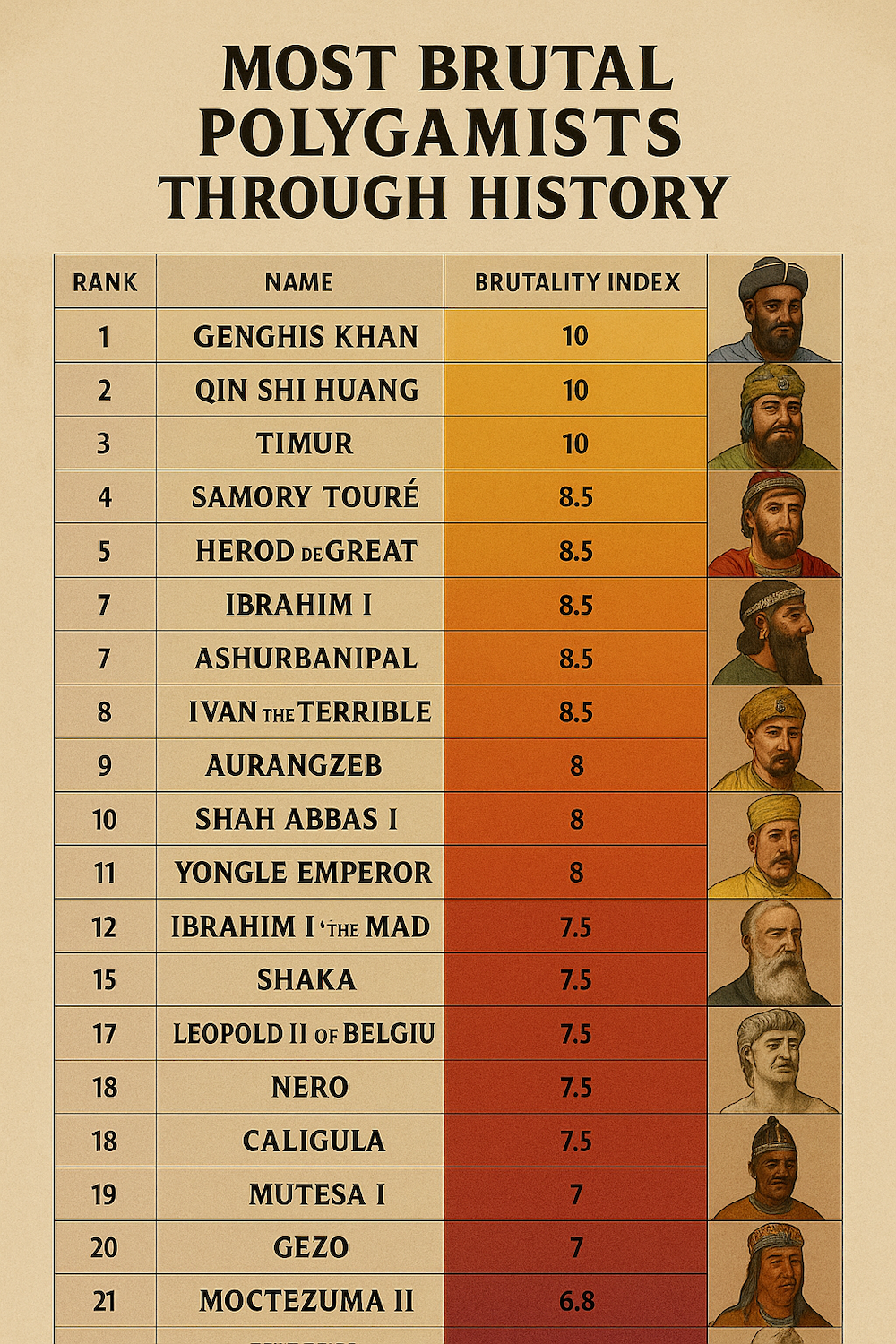
Rulers like Herod the Great, who ordered the killing of babies during Jesus’s lifetime, fit a clear trend: brutal rulers are often polygamists, but, of course, not all polygamists are brutal.
Even if God had given Saul’s wives to David as wives—which the text never says—that still wouldn’t mean God commanded polygamy or established eternal plural marriage. At most, it shows tolerance, not approval.
And that’s the real issue. Section 132 doesn’t just tolerate polygamy—it commands it and promises eternal polygamy. And that puts it in direct conflict with the biblical pattern.
Do Unto Others
Here’s a familiar verse—the Golden Rule. In Matthew 7:12, Jesus teaches that we should treat others the way we want to be treated.
Therefore all things whatsoever ye would that men should do to you, do ye even so to them: for this is the law and the prophets.
Jesus taught that the heart of “the law and the prophets”—a summary of the entire Old Testament—is this: we are to care for others enough to treat them the way we ourselves would want to be treated.
That principle is foundational. Yet if one believes that taking multiple wives is divinely sanctioned, it raises an obvious question: what would “treating others as you want to be treated” actually look like in practice?

If a man truly applied the Golden Rule to himself in the context of polygamy, he would have to accept the same arrangement for his wife. That would mean being willing for her to take additional husbands—often men much younger than himself. This age imbalance frequently happens in polygamy, including in the early-church.

This chart of some early church leaders shows the large age difference. Is it because younger women were more fertile, more attractive, or was it because the men were running out of women closer to their own age? I don’t know. I do know God created the world with roughly equal numbers of men and women, which already tells us something about His design for marriage.
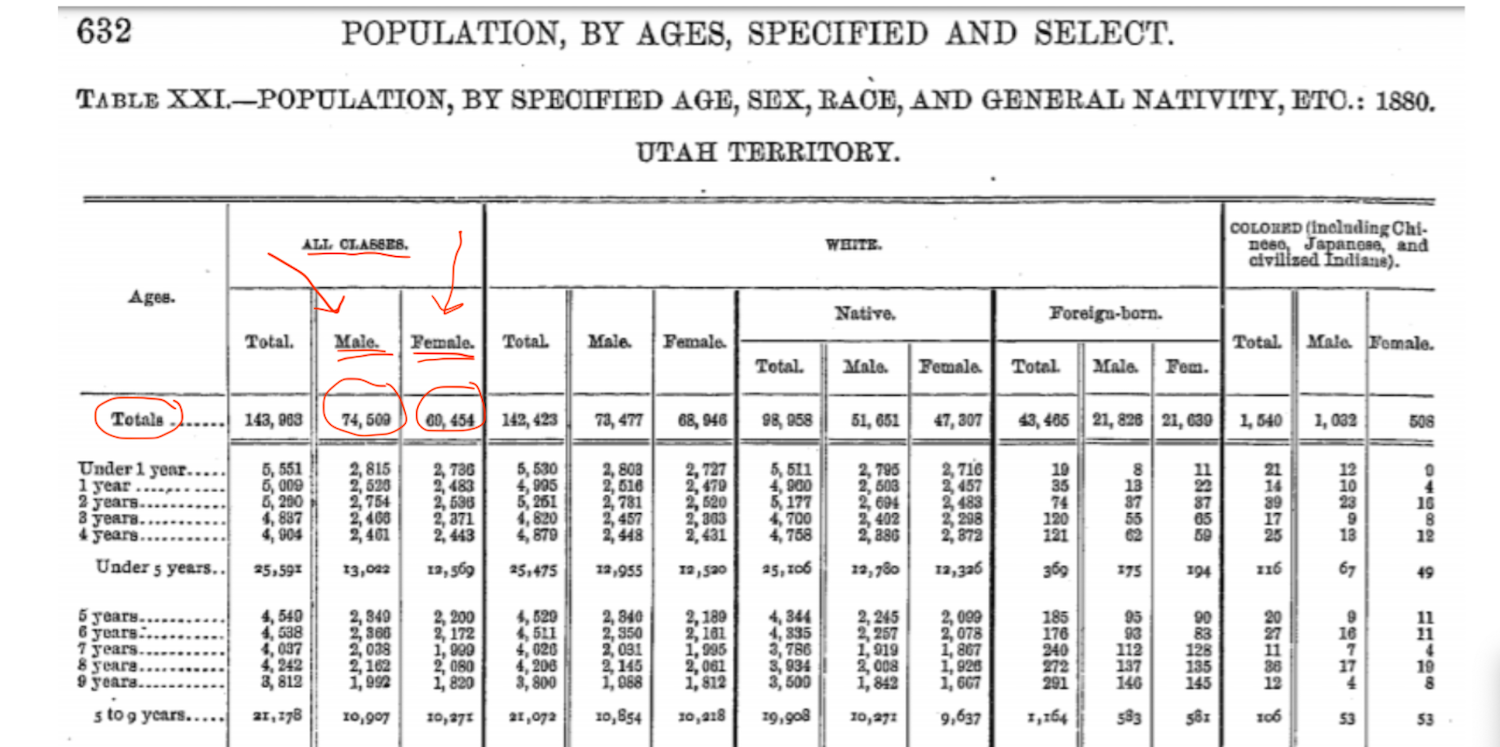
Early Utah was no exception to God’s arrangement. I was taught that early Utah had more women than men, and that plural marriage was therefore necessary. There weren’t more women than men, but even if there were, it wouldn’t justify polygamy. I didn’t during King Limhi in the Book of Mormon. Like so many explanations I once accepted, this one doesn’t hold up either.
It’s reported that Heber Kimball said the following in 1855:
“I wish more of our young men would take to themselves wives of the daughters of Zion, and don’t wait for us old men to take them all.”
That statement suggests older men married young women because younger men weren’t stepping up. But another explanation makes more sense: the older men took the young wives first, leaving very few for the younger men.
In polygamous societies, that’s a common pattern—lower-status men are often left without wives. So polygamy doesn’t just harm women; it also harms men by allowing a few to take more than their share.
Jacob 2:31 captures God’s response to this system. He says He has seen the sorrow and heard the mourning of women in all the lands of His people because of the abominations of their husbands.
Jacob2: 31 For behold, I, the Lord, have seen the sorrow, and heard the mourning of the daughters of my people in the land of Jerusalem, yea, and in ALL THE LANDS OF MY PEOPLE, because of the wickedness and abominations of their husbands.
So the real issue isn’t age differences. The issue is marrying more than one wife. Polygamy causes heartbreak. And no man wants his own heart broken. A man who truly follows Christ’s teaching to treat others as he wants to be treated would never choose a practice that breaks his wife’s heart. And perhaps we can also say that he should not adopt a practice that effectively deprives other men of the chance to marry.
Not Burdensome
We are told in 1 John that this is the love of God, that we keep his commandments: and his commandments are not grievous.
For this is the love of God, that we keep his commandments: and his commandments are not grievous.
As Moses is preparing to lead God's people from their encampment near Mt Sanai, he says in Deuteronomy 10:12-13 "And now, Israel, what does the Lord your God ask of you but to fear the Lord your God, to walk in obedience to him, to love him, to serve the Lord your God with all your heart and with all your soul, and to observe the Lord’s commands and decrees that I am giving you today for your own good?” God’s commandments are not burdensome, and they are given for our own good.
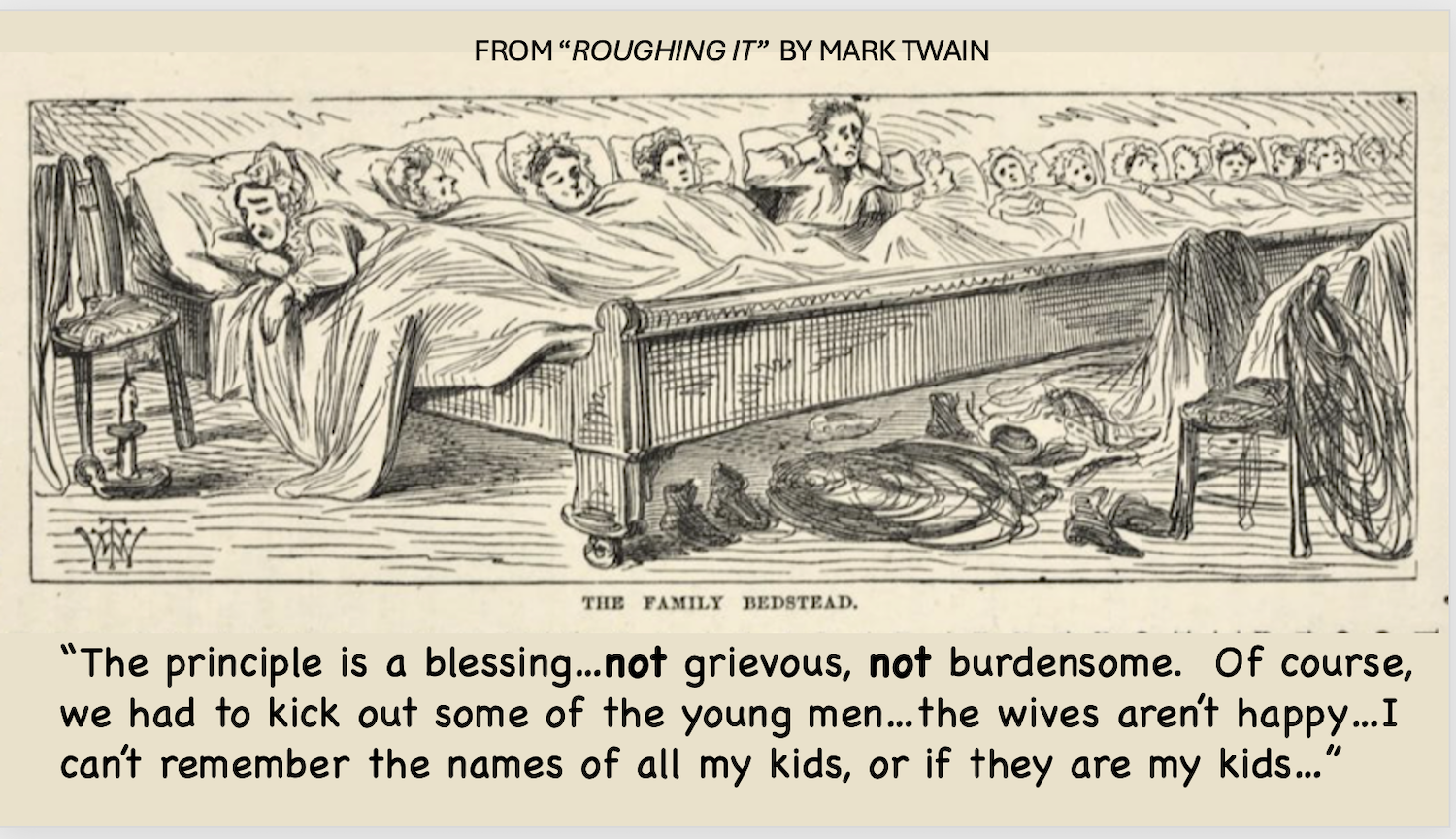
This illustration is from Mark Twain’s Roughing It, which describes his travels through the American West from 1861 to 1867. The highlight of his book, for me anyway, is a visit to Salt Lake City. This illustration of a very anxiety-ridden polygamous man is titled “The Family Bedstead.” I’ve added the caption.
After the LDS Church publicly acknowledged plural marriage at its 1852 conference, Brigham Young sent Apostle Orson Pratt to Washington, D.C. to publish The Seer, an apologetic magazine aimed at non-Mormons. Written almost entirely by Pratt, the magazine’s primary purpose was to explain and defend Mormon doctrine—especially plural marriage.
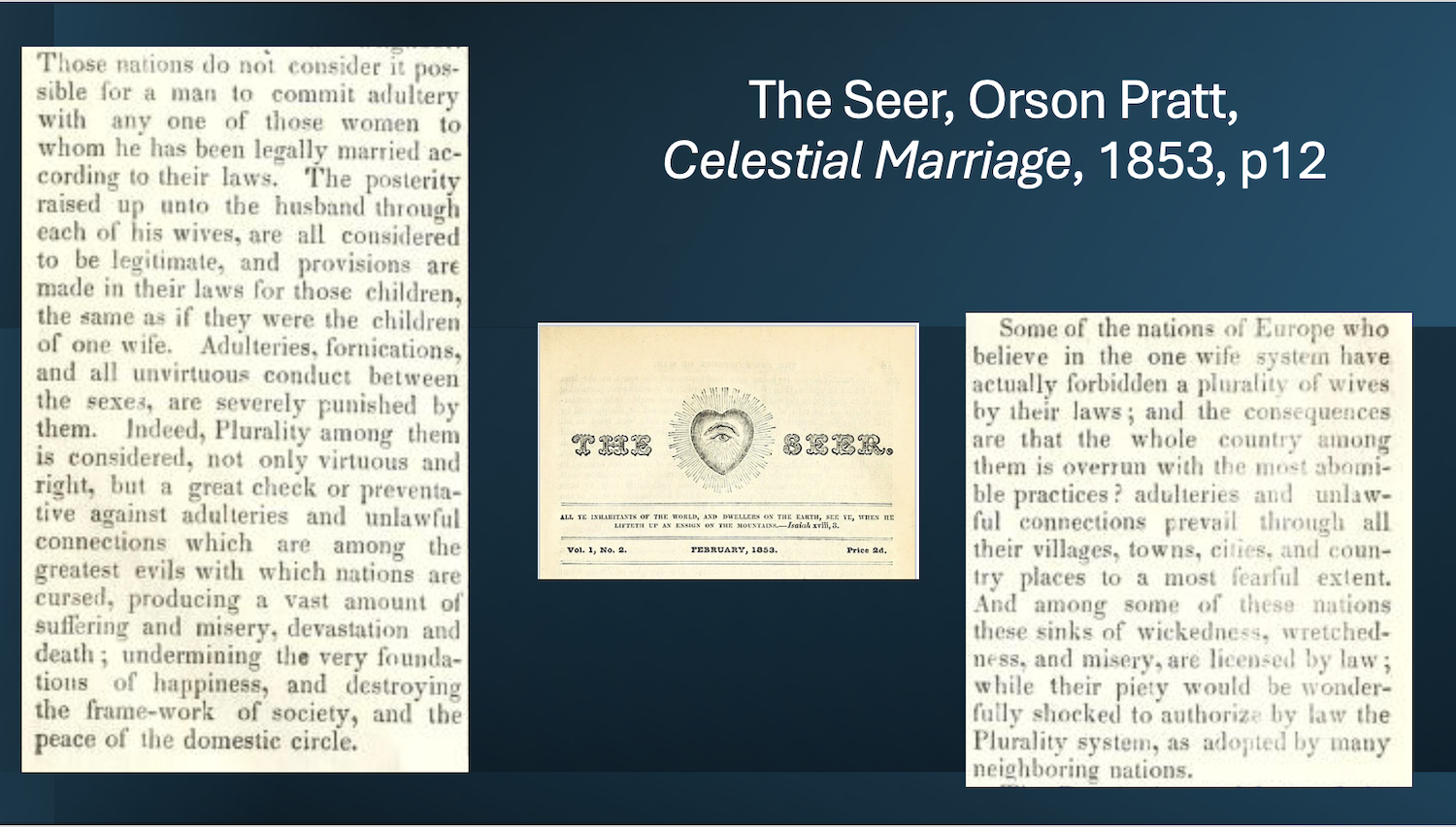
Pratt repeatedly argued that plural marriage was rational, widespread, and morally superior. He claimed it was practiced by powerful nations in Asia and Africa, by island nations, and by Indigenous peoples of the Western Hemisphere, and that it prevented adultery. By contrast, he criticized European nations for outlawing polygamy, asserting that their societies were “overrun with adulteries and unlawful connections.”
What is striking is Pratt’s confidence. He offered no evidence that societies flourish because of polygamy. In his defence, he lacked access to data now available—data showing that polygamous systems harm men, women, children, families, and societies as a whole.
Yet God ALWAYS has our best interest at heart. God’s commandments are not grievous; they don’t cause damage, but are intended for our good. Plural marriage has never aligned with this scriptural description.
In 2011 British Columbia Supreme Court Chief Justice Robert Bauman wrote that the ban on polygamy prevents "sundry harms”…”There can be no alternative to the outright prohibition," Bauman wrote. "... There is no such thing as so-called 'good polygamy.' "
The fact that it causes harm was determined twice in the courts of British Columbia. Originally, in 2011 and then the ban on polygamy was upheld again in 2018.
Seven Women
Isaiah 4:1 is a verse Orson Pratt used to justify polygamy. It says:
“And in that day seven women shall take hold of one man, saying, We will eat our own bread, and wear our own apparel: only let us be called by thy name, to take away our reproach.”
What’s often missed is that Isaiah 4:1 doesn’t stand alone. Scholars agree it belongs with Isaiah chapter 3, which describes God’s judgment on Jerusalem for her wickedness.
Chapter 3 paints a picture of collapse. War has devastated the land. Men have been killed. Leadership is gone. Society is unraveling. Women lose security and protection, and men desperately look for anyone who can lead.
Isaiah 3:6 captures that desperation:
“When a man shall take hold of his brother… saying, Thou hast clothing, be thou our ruler, and let this ruin be under thy hand.”
So in this broken society, men are searching for rulers, and women are searching for survival.
That’s the setting for Isaiah 4:1. The seven women represent a war-torn Jerusalem clinging to one of the few surviving men—not because God is endorsing polygamy, but because judgment has left the society in ruins.
Orson Pratt used this passage in Isaiah to argue for polygamy in the end times. And it’s easy to imagine the picture he may have had in mind—a kind of idealized, divinely approved marriage system.
But that’s not what Isaiah is describing at all. Isaiah isn’t painting a rosy future. He’s describing desperation. It’s not a prescription for godly living. It’s a consequence of abandoning God.
And there’s another problem with using this verse to defend polygamy: even if war temporarily skewed the population, that imbalance would last only one generation. The next generation would again be born roughly half male and half female. The birth rate itself contradicts the idea that polygamy is God’s enduring design.
Using Isaiah 4:1 to justify polygamy doesn’t honor the text—it ignores its warning and turns a picture of judgment into a doctrine God never taught.
Here is a oneclimbs post that clarifies this scripture.
Vex a Sister
A video from 119 Ministries explains an important scripture verse with more detail than I will provide. I highly recommend this video. I also benefited from a post titled The Biblical Prohibition of Polygamy.
Before getting to that verse, I want to start with Paul’s words in 1 Timothy 3:2, and he said something similar in Titus 1:6.
A bishop then must be blameless, the husband of one wife, vigilant, sober, of good behaviour, given to hospitality, apt to teach
And in 1 Corinthians 7:2
Nevertheless, to avoid fornication, let every man have his own wife, and let every woman have her own husband.
Paul wrote to the Ephesians, which becomes one of the seven scriptures instructing a man to be joined to his one wife. In Ephesians 5:31, we read:
For this cause shall a man leave his father and mother, and shall be joined unto his wife, and they two shall be one flesh.
In the video, the question is raised: where in the Torah would Paul have found such clear instruction against polygamy? And how would that instruction justify his conclusion that an elder who practiced polygamy was not modeling righteous living?
In Leviticus 18:18, we read:
Neither shalt thou take a wife to her sister, to vex her, to uncover her nakedness, beside the other in her life time.
Sister wives in the Old Testament managed to vex each other, whether they were actual sisters or not.
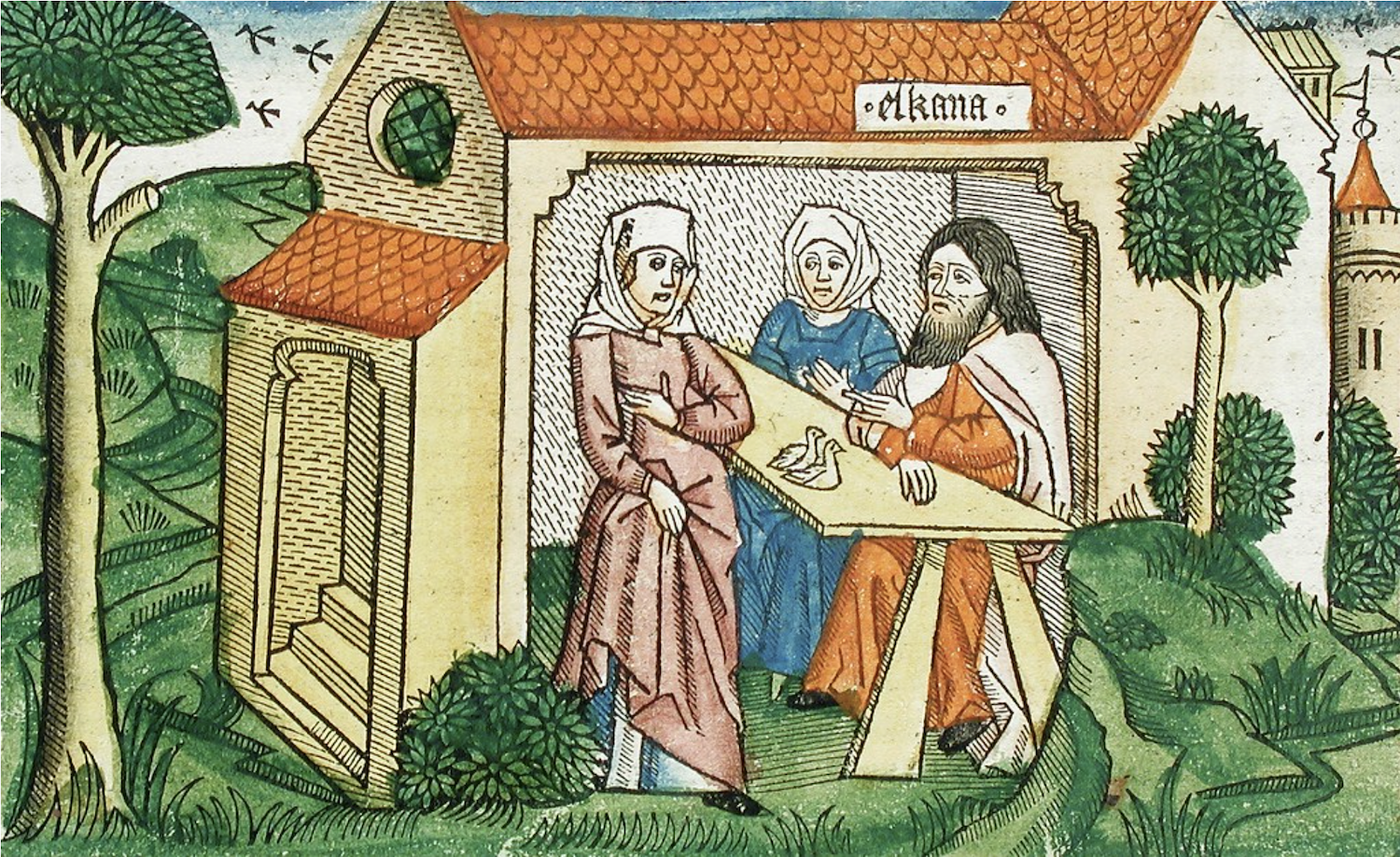
Elkanah with his Two Wives, Ninth German Bible (Cologne Bible) (Anton Koberger: Nurenburg: 1483) Los Angeles County Museum of Art
Here’s one example: Elkanah had two wives, Hannah and Peninnah. Peninnah had children; Hannah did not. Most people remember Hannah as the mother of Samuel. The two women were not sisters—but there was still plenty of conflict. Scripture says Peninnah deliberately provoked Hannah and caused her deep anguish.
That’s important, because Leviticus 18:18 warns against taking another woman who would become a rival. Elkanah’s family shows exactly what that looks like in real life. Even when the wives aren’t sisters, polygamy still produces rivalry, pain, and injustice.
What if, instead of forbidding marriage to two sisters, Leviticus 18:18 is actually forbidding polygyny altogether?
One reason this question comes up is the Hebrew phrase “ishah el ahotah”—literally “woman to her sister.” When those words are used together, they often function more like an idiom than a literal description. In fact, that phrase appears eight other times in Scripture, where it means “one to another.”
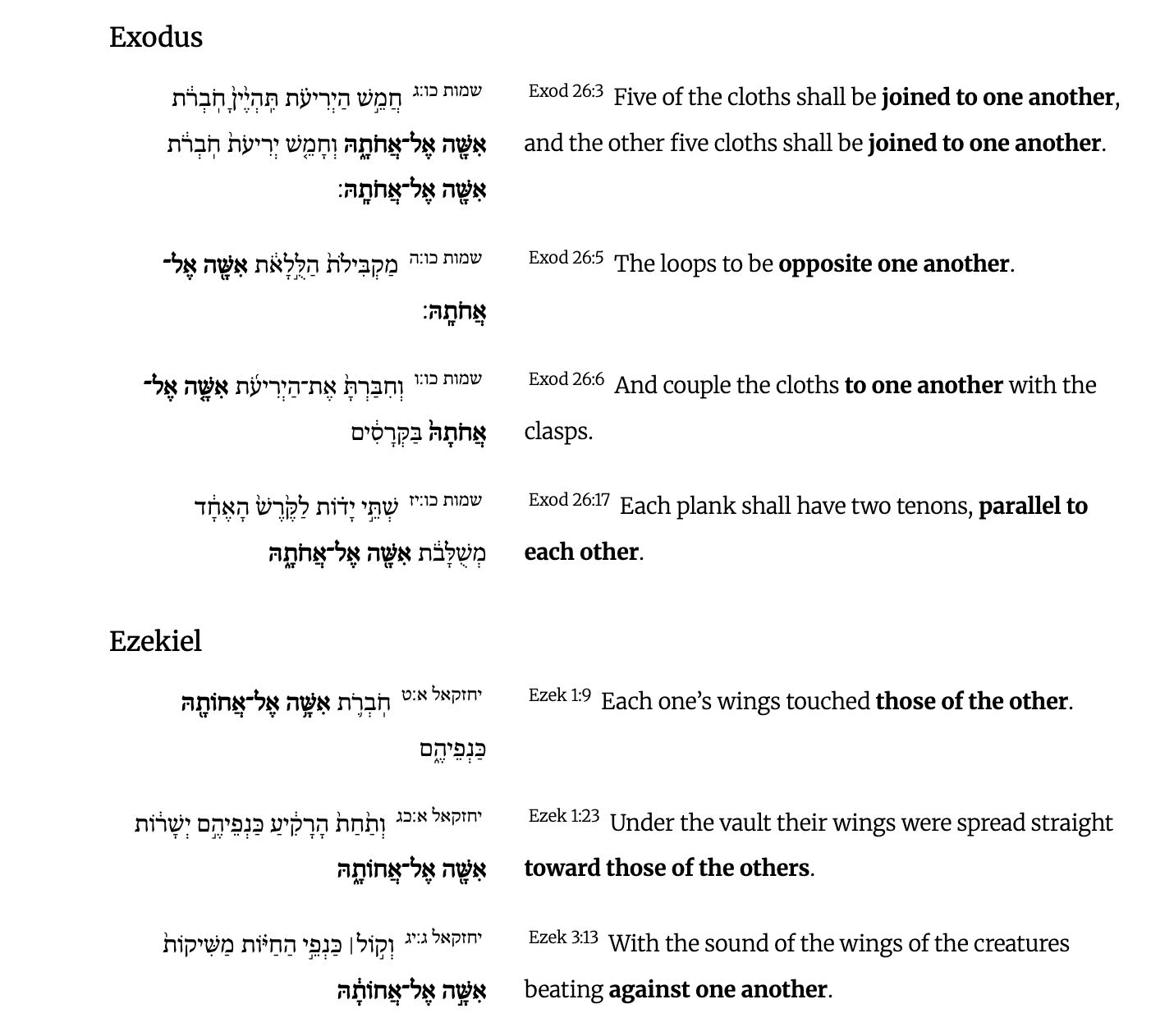
Screenshot from The Torah.com
So instead of talking about two sisters, the passage may be talking about two women. That idea comes through more clearly in Young’s Literal Translation, which renders the verse this way:
'And a woman unto another thou dost not take, to be an adversary, to uncover her nakedness beside her, in her life.
Read that way, the warning isn’t about sisters at all—it’s about taking another woman who would inevitably become a rival. In other words, the text forbids polygamy itself. And that helps explain why Paul could say that a man living in polygamy was not modeling righteous living.
Thou Shalt Not Commit Adultery
We’re all familiar with the 7th of the 10 commandments:
Thou Shalt Not Commit Adultery
This scripture is not black and white in the Old Testament. In Leviticus 20:10 we read:
And the man that committeth adultery with another man's wife, even he that committeth adultery with his neighbour's wife, the adulterer and the adulteress shall surely be put to death.
Notice what the verse actually says—and what it doesn’t say. It clearly defines adultery as a man sleeping with another man’s wife, but it doesn’t spell out whether the man himself is married or unmarried, which pro-polygamists love. It leaves some ambiguity in how adultery was legally defined in ancient Israel. I believe that Leviticus 18:18 would resolve the ambiguity, but for argument’s sake, let’s say it doesn’t.
What we see in the Old Testament is that God often regulated practices that already existed in the surrounding culture, rather than immediately eradicating them. Polygamy is one example. Slavery is another. God’s tolerance of these practices doesn’t mean endorsement—it reflects patience with a deeply entrenched cultural reality.
So yes, figures like Jacob, David, and Solomon were not struck down on the spot for practicing polygamy. But that is not a justification for treating polygamy as God’s ideal or as something to imitate. Scripture repeatedly shows that polygamy brings conflict, injustice, and misery—especially for women.
Even within the Old Testament, the trajectory is clear. The creation model is one man and one woman. Marriage imagery throughout Scripture points back to that standard. God never commands polygamy, and there is no biblical basis for the idea of eternal polygamy.
If you’re still not convinced, and you believe the Book of Mormon, it clears up any ambiguity in the Old Testament. In Jacob 2, we’re told that he led His people out of Jerusalem, where the polygamy was happening, to raise up a righteous seed that was to come from one man and one wife.
25 Wherefore, thus saith the Lord, I have led this people forth out of the land of Jerusalem, by the power of mine arm, that I might raise up unto me a righteous branch from the fruit of the loins of Joseph.
26 Wherefore, I the Lord God will not suffer that this people shall do like unto them of old.
27 Wherefore, my brethren, hear me, and hearken to the word of the Lord: For there shall not any man among you have save it be one wife; and concubines he shall have none;
Jacob doesn’t praise polygamy. He condemns it. He points directly to David and Solomon and says their many wives were an abomination before God.
When we reach the New Testament, ambiguity also disappears. Marriage is assumed to be monogamous. Jesus points back to creation. Paul treats monogamy as the norm. Church leaders are described in explicitly monogamous terms. There is no place where polygamy is presented as acceptable in the Christian church.
So while the Old Testament records what people practiced, the New Testament clarifies what God intends. Scripture consistently moves toward monogamy as the standard for marriage. In other words, more than one wife would be adultery.
So the question becomes: how does a polygamist get around the commandment against adultery?
Anything that would normally be called an adulterous relationship suddenly has a simple fix. Instead of restraining desire, the solution is to add another marriage. Once a woman is married to him, the charge of adultery disappears.
What would have been sin is now reframed as obedience. Desire doesn’t have to be mastered — it just has to be authorized.
Here’s D&C 132, verse 62, which justifies marrying additional wives.
62 And if he have ten virgins given unto him by this law, he cannot commit adultery, for they belong to him, and they are given unto him; therefore is he justified.
I see it as a highly coercive text—one that dictates the sexual use of women as plural wives, without their input or consent. Verse 62 justifies marrying additional virgins given to a man. In this case, he can marry up to 10 virgins. But leaders often had more. One of Brigham Young’s wives, not a virgin though, left her husband and children to become a plural wife to him, even though she was still married to her first husband
On Find a Grave, we read,
“Augusta, daughter of John and Mary Ives Adams, married (1) Henry Cobb on December 22, 1822 in Charlestown MA. They had nine children. In 1842, Brigham Young was on a mission in the Boston area and met Augusta. They fell in love and she abandoned all but the two youngest children, and moved to Nauvoo, Illinois. During the trips, her baby boy, named George "Brigham" Cobb, died. Once there, she married Brigham Young as his 2nd plural wife (out of some 45-55 wives total), without first divorcing husband Henry. Henry sued for divorce in 1846 and in 1847, the Massachusetts State Supreme Court granted them a divorce on the basis of her adultery with Brigham Young.”
The Still Mormon video offers valuable insights into this relationship.
The point is this: when marriage is redefined or blurred, adultery becomes easier to excuse.
Brigham felt justified in taking a woman as a plural wife even though he was already married. That alone constitutes adultery. And in this case, the woman was also married. While he may not have seen it as adultery, the Massachusetts State Supreme Court did.
As flawed humans, we all fail on some level. But rather than admitting we are sinners, polygamy changes the commandment to justify the sin and turn it into a virtue.
Levirate Marriage
Levirate marriage is sometimes used to defend polygamy—but it has nothing to do with promoting polygamy. The word levirate simply means “brother-in-law.” In Deuteronomy 25:5, we read:
5. If brethren dwell together, and one of them die, and have no child, the wife of the dead shall not marry without unto a stranger: her husband's brother shall go in unto her, and take her to him to wife, and perform the duty of an husband's brother unto her.
Its purpose is stated clearly in verse 6.
6. And it shall be, that the firstborn which she beareth shall succeed in the name of his brother which is dead, that his name be not put out of Israel.
This law applies to a very specific situation: when a man dies childless, his brother may father a child in the dead man’s name, so that his name and inheritance are not lost in Israel. That’s the point—inheritance, not expanding marriage.
Israel’s land was sacred. It had to stay within families and tribes, as reinforced in Numbers 36 and Leviticus 25. Levirate marriage protected widows and preserved family land.
Polygamy could occur, but it wasn’t the goal, and it wasn’t the norm. Typically, the eldest son would marry first and have children before the younger sons married. If the eldest son had children, his wife, upon becoming a widow, would not need to marry the younger brother.
God is not encouraging polygamy here—He’s regulating a fallen society to protect inheritance and vulnerable women. And as I’ve said before, these verses do not command polygamy, and they certainly do not introduce eternal plural marriage.
Lusting
In the Sermon on the Mount, recorded in Matthew 5, Jesus says that adultery doesn’t begin with an action — it begins in the heart. In Matthew 5:27-29, he said,
“Ye have heard that it was said by them of old time, Thou shalt not commit adultery: But I say unto you, That whosoever looketh on a woman to lust after her hath committed adultery with her already in his heart. And if thy right eye offend thee, pluck it out, and cast it from thee: for it is profitable for thee that one of thy members should perish, and not that thy whole body should be cast into hell.”
I recommend a comprehensive video from the 119 Ministries that has a worthwhile interpretation of these verses and a lot more detail than I will provide. They look at the original translations and surrounding verses to conclude that:
Sexual desire itself is not sinful.
Jesus's prohibition against looking at a woman with lustful intent was essentially Him just repeating the Tenth Commandment against coveting.
Coveting involves the intentional focusing of one's desires on what is forbidden—technically on something or someone that rightfully belongs to another.
Jason A. Staples in "Whoever Looks at a Woman With Lust: Misinterpreted Bible Passages #1"
“If this passage is to be correctly taught, the emphasis should not be upon “sexual thoughts” or “lust”; instead, the emphasis should be placed squarely on the will: that is, “What is the proper response to sexual desire?” Sexual desires are not inherently sinful; the exercise of the sexual appetite outside appropriate boundaries is the problem. The point in this passage is that once the will has turned toward illicit behavior, sin has already entered the heart and, once fully conceived, will bring forth death. The emphasis should therefore be upon willfully bending natural desires away from illicit objects (or persons) and toward what is right.”
While 119 Ministries and Jason Staples do not mention polygamy, more than one wife is a perfect example of the problem being described. “Lust” itself is not a sin, but leads to sin if it is not properly governed. That is exactly what D&C 132 allows. Look at verse 61:
And again, as pertaining to the law of the priesthood—if any man espouse a virgin, and desire to espouse another, and the first give her consent, and if he espouse the second, and they are virgins, and have vowed to no other man, then is he justified; he cannot commit adultery for they are given unto him; for he cannot commit adultery with that that belongeth unto him and to no one else.
The 132 reasoning goes something like this: if a man desires or lusts after another woman besides his one wife, then he can make that desire acceptable by marrying her—desire itself becomes a justification for adultery. Once a woman is “given” to a man, adultery is no longer a sin.
As Jason Staples says, “Sexual desires are not inherently sinful; the exercise of the sexual appetite outside appropriate boundaries is the problem.” More than one wife is outside of the appropriate boundaries.
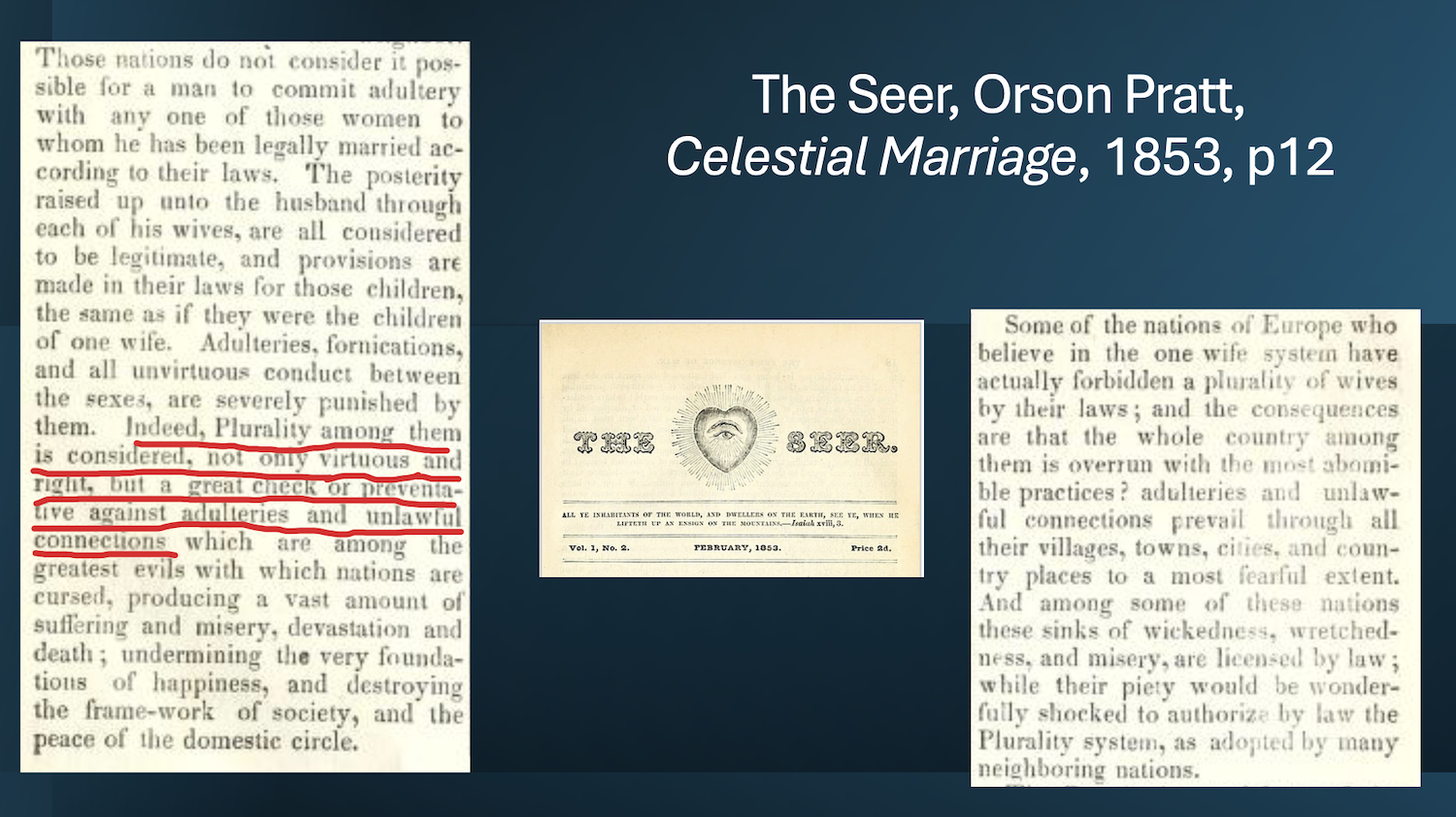
Now contrast that with Orson Pratt’s argument in The Seer. He claimed that so-called enlightened nations viewed plural marriage as a virtue because, in theory, unlimited wives would prevent adultery and unlawful connections.
But history doesn’t support that claim.
It didn’t work for early church polygamists, and it didn’t work in the Old Testament either. King David is the clearest example. Despite having multiple wives, he still felt entitled to desire—and take—a married woman. Plural marriage didn’t restrain lust. It expanded entitlement.
By making desire and lust and the jumping off point for multiple wives, which is adultery, 132 is excusing sin.
In 1 John 1:8-10, it says if we claim we have no sin, we deceive ourselves. But if we confess our sins, God is faithful to forgive and cleanse us. Are pro-polygamists denying their sin and therefore missing out on our Savior’s forgiveness?
Jesus didn’t condemn desire — He called us to govern it. Plural marriage doesn’t restrain lust; it excuses it.
Loved or Unloved
Another passage often cited to suggest that God condoned polygamy is Deuteronomy 21:15-17.
If a man have two wives, one beloved, and another hated, and they have born him children, both the beloved and the hated; and if the firstborn son be hers that was hated:
Then it shall be, when he maketh his sons to inherit that which he hath, that he may not make the son of the beloved firstborn before the son of the hated, which is indeed the firstborn:
But he shall acknowledge the son of the hated for the firstborn, by giving him a double portion of all that he hath: for he is the beginning of his strength; the right of the firstborn is his.
The law states that if a man has two wives—one loved and one “hated”—and the firstborn son belongs to the less-favored wife, the father may not deny that son his rightful inheritance. Under ancient inheritance law, the firstborn received a double portion, regardless of the father’s personal feelings.
But regulating inheritance does not equal endorsing polygamy. Laws exist to limit harm within broken or imperfect situations. Dennis Prager, in his book on Deuteronomy, notes that the Torah’s use of the harsh word “hated” is intentional. Polygamy is portrayed negatively, not idealized, such as Jacob’s marriages to Rachel and Leah.
“The Torah teaches right and wrong not only through law, but through its stories. Three thousand years ago, polygamy was the norm in all societies. There is every reason to believe that an outright ban would have been ignored; and it was a principle of Talmudic jurisprudence that one does not legislate a prohibition that will be widely violated.”
Dennis says that turning one’s country into a nation of lawbreakers is bad for society, as the U.S. learned when it passed an amendment banning the sale of alcohol. Prohibition led to widespread non-compliance, accompanied by a significant increase in crime.
Here’s something else to consider. In the Jamieson-Fausset-Brown Bible Commentary, we read:
15-17. If a man have two wives, one beloved, and another hated—In the original and all other translations, the words are rendered "have had," referring to events that have already taken place; and that the "had" has, by some mistake, been omitted in our version, seems highly probable from the other verbs being in the past tense—"hers that was hated," not "hers that is hated"; evidently intimating that she (the first wife) was dead at the time referred to. Moses, therefore, does not here legislate upon the case of a man who has two wives at the same time, but on that of a man who has married twice in succession, the second wife after the decease of the first; and there was an obvious necessity for legislation in these circumstances; for the first wife, who was hated, was dead, and the second wife, the favorite, was alive; and with the feelings of a stepmother, she would urge her husband to make her own son the heir. This case has no bearing upon polygamy, which there is no evidence that the Mosaic code legalized.
According to this commentary, the correct translation indicates that these were not simultaneous wives. After the first wife had died, the second wife—the living, favored stepmother—might pressure her husband to make her son the heir. If this explanation is correct, the passage has nothing to do with polygamy at all.
Either way, the text does not show God condoning polygamy, much less commanding it. I don’t see eternal plural marriage in these passages either.
The Anti-Polygamy Book
The anti-polygamy Book of Mormon consistently condemns the practice of having many wives and concubines. And there is certainly no mention of eternal plural marriage. Here are some of the scriptures that send a clear message:
Jacob 2:24
Behold, David and Solomon truly had many wives and concubines, which thing was abominable before me, saith the Lord.
Mosiah 11:2
For behold, he did not keep the commandments of God, but he did walk after the desires of his own heart. And he had many wives and concubines….
Ether 10:5
And it came to pass that Riplakish did not do that which was right in the sight of the Lord, for he did have many wives and concubines…
So how does a polygamist handle the Book of Mormon?

They wrest Jacob 2: verse 30 to say this vague verse surrounded by verses that call it an abominable whoredom that breaks the hearts of all women is sometimes commanded. Here’s a post that explains that verse.
The Church consistently lets us know that monogamy is the standard, but sometimes God will command polygamy. They say it over and over and over and even teach it to our children. In 2 Nephi 3:12, we read:
Wherefore, the fruit of thy loins shall write; and the fruit of the loins of Judah shall write; and that which shall be written by the fruit of thy loins, and also that which shall be written by the fruit of the loins of Judah, shall grow together, unto the confounding of false doctrines and laying down of contentions, and establishing peace among the fruit of thy loins, and bringing them to the knowledge of their fathers in the latter days, and also to the knowledge of my covenants, saith the Lord.
Only in D&C 132 is polygamy commanded. Even IF the Bible isn’t explicitly condemning polygamy in Leviticus 18:18, God made His ideal for marriage clear throughout Scripture: one man with one woman. And whenever polygamy is described it is negatively. A lesson to be learned from some horrible outcomes.If you believe the Book of Mormon, in 2 Nephi 3:12, we we are told the Book of Mormon shall grow together with the Bible, “unto the confounding of false doctrines and laying down of contentions.” If that’s true, I can’t think of a falser doctrine that has caused more harm and contention than this one. Plural marriage deserves to be confounded.